Common Use Cases of Purchase Order Approval Workflows for Procurement Teams
Purchase order approval workflows show how structured automation transforms procurement operations across organizations of all sizes. Without a formal approval process, procurement teams struggle with delayed decisions, compliance gaps, and inconsistent policy enforcement that expose the business to financial and regulatory risk. Modern workflows eliminate manual handoffs, enforce purchasing policies at the point of request, and provide real-time visibility into approval status, enabling teams to focus on strategic sourcing instead of chasing signatures.
Key Takeaway
Structured purchase order approval workflows automate routing decisions based on spend thresholds, categories, and vendors while maintaining complete audit trails, reducing approval cycles and strengthening compliance controls across the entire organization.
In This Article
- Why Purchase Order Approval Workflows Matter in Today’s Procurement Environment
- Core Procurement Challenges Without Structured Approval Workflows
- How Purchase Order Approval Workflows Address These Challenges
- Real-World Purchase Order Approval Workflow Use Cases
- Industry-Specific Applications
- Key Benefits of Structured Purchase Order Approval Workflows
- How to Implement a Purchase Order Approval Workflow
- Frequently Asked Questions
Why Purchase Order Approval Workflows Matter in Today’s Procurement Environment
Modern procurement operates in a complex landscape where regulatory compliance, decentralized decision-making, and multi-vendor ecosystems demand structured controls. According to Deloitte’s Global Procurement Report, organizations struggle with spend visibility. In fact, 60% can’t track total spending across all vendors and cost centers. On top of that, digital transformation efforts have exposed critical gaps in approval processes that rely on email chains, spreadsheets, and manual sign-offs.
The challenge gets worse as organizations scale. What works for a 20-person team with one approval chain breaks down when you’re handling hundreds of purchasing requests daily across multiple departments, vendors, and cost centers. That’s why businesses increasingly turn to automated workflows to enforce policy, reduce cycle time, and create compliance documentation that satisfies internal audits and regulatory requirements.
Beyond compliance, there’s another pressure on procurement teams: deliver value beyond transactional purchasing. Strategic sourcing, vendor relationship management, and cost optimization require time and attention. Yet many teams remain trapped in administrative work. Here’s the thing: structured workflows free up that capacity by automating routine decisions and escalations.
“Organizations that implement digital procurement solutions report 35-50% reduction in procurement cycle time and improved spend visibility across all purchase categories.”
Gartner Magic Quadrant for Procurement Solutions, 2024

Core Procurement Challenges Without Structured Approval Workflows
Procurement teams relying on informal approval processes face predictable operational and financial risks. These challenges compound as purchasing volume grows and organizational complexity increases.
- Delayed approvals and bottlenecks: Manual approval chains mean critical POs sit in inboxes waiting for busy executives to sign off, delaying vendor orders and project timelines.
- Inconsistent policy enforcement: Without system-enforced rules, some departments follow purchasing policies while others bypass them, creating uncontrolled spending and contract violations.
- Compliance and audit trail gaps: Email approvals and verbal sign-offs leave no clear documentation, making it impossible to prove who authorized a purchase or when approval occurred.
- Rogue spending and budget overruns: Lack of budget validation means departments can exceed allocated spend without detection until month-end accounting reconciliation.
- Manual follow-ups consuming staff time: Procurement staff spend hours chasing down approvers, resending requests, and tracking status instead of analyzing vendor performance or negotiating contracts.
- Lack of spend visibility and reporting: Without centralized tracking, finance and procurement lack real-time insight into who is spending what, with whom, and whether spending aligns with budgets and contracts.
These gaps expose the organization to financial, compliance, and operational risk. In regulated industries like healthcare and finance, audit findings related to lack of spend controls can trigger enforcement actions or require expensive remediation efforts.
How Purchase Order Approval Workflows Address These Challenges
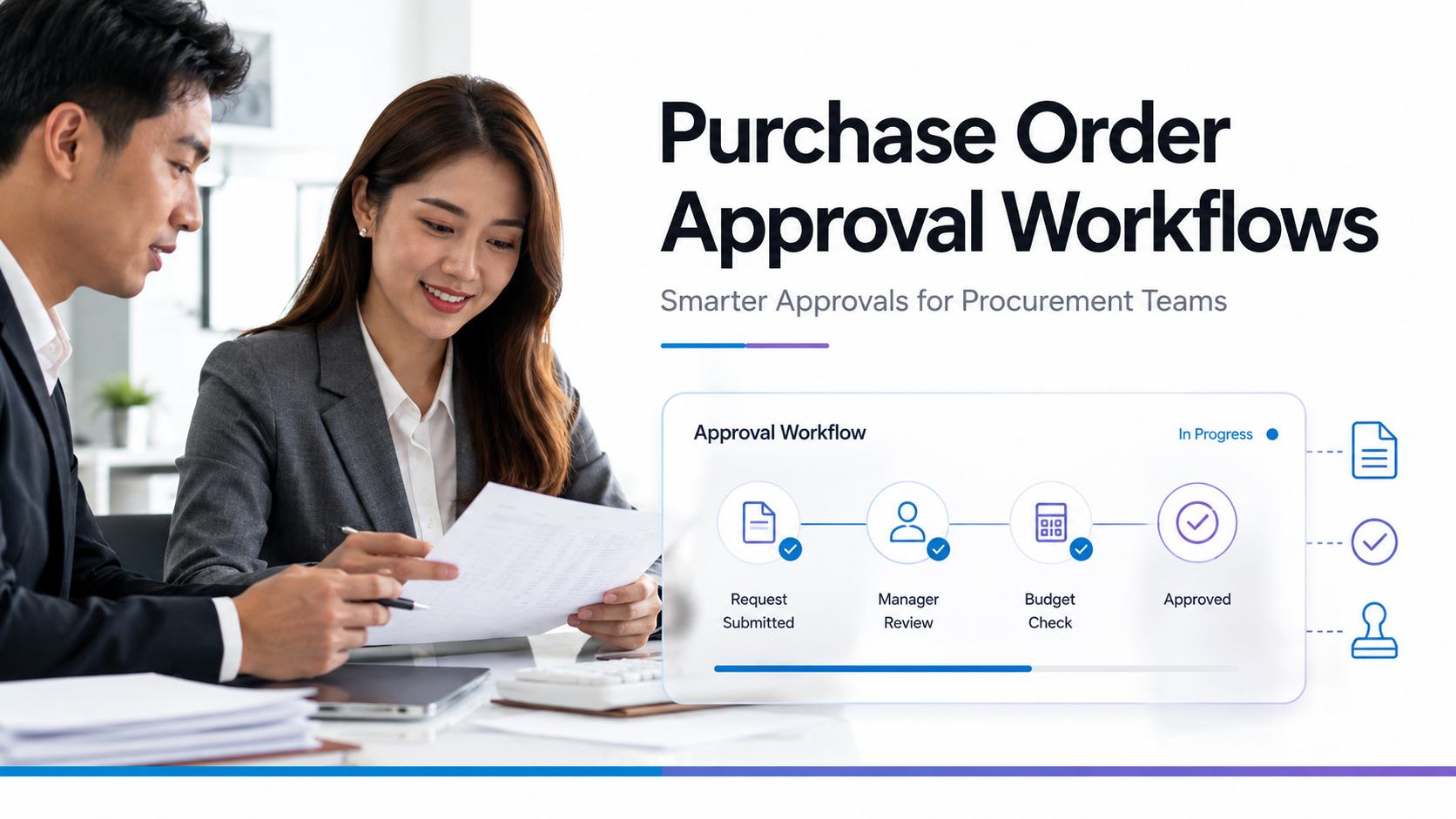
Purchase order approval workflows solve these challenges by automating decision routing, enforcing policy rules, and maintaining a complete audit trail of all approvals. Unlike email-based processes, structured workflows ensure no approval request falls through the cracks and every PO complies with organizational policy before issue.
At their core, these workflows route purchase requests to the correct approvers based on predefined rules. For example, a workflow might route orders under $5,000 to a department manager, orders between $5,000 and $50,000 to a director, and orders exceeding $50,000 to the CFO. Similarly, IT equipment might route to an IT manager while vendor contracts route to both procurement and legal. This ensures subject-matter experts review relevant purchases and appropriate governance levels prevent both bottlenecks and unauthorized spend.
Here’s what’s important: workflows validate critical information before sending for approval. Budget checks prevent overspending. Cost center validation ensures correct accounting coding. Vendor compliance gates verify that new suppliers meet regulatory and risk requirements. These automated validations reduce the burden on approvers and prevent errors that create rework downstream.
Expert Perspective
In our work with clients, we’ve found that workflows integrated into Microsoft 365 SharePoint eliminate parallel systems and reduce user friction. Since teams already use email, Teams, and SharePoint daily, embedding approval workflows into these familiar tools drives faster adoption and higher engagement than standalone procurement platforms.
Worth noting: workflows provide real-time visibility into approval status. Requestors can see their PO is pending approval from a specific person, not wonder if it was received. Procurement can run reports on approval cycle times, identify bottlenecks, and optimize escalation rules. Finance gains visibility into pending commitments and can forecast cash flow more accurately.
And here’s the thing: every approval leaves an audit trail. Who approved it? When? What was the business justification? These records satisfy compliance requirements and internal audits without requiring procurement staff to manually reconstruct approval history from email threads.
Real-World Purchase Order Approval Workflow Use Cases
Use Case 1: Multi-Level Approval by Spend Threshold
Scenario: A manufacturing company routes purchase orders based on dollar amount. Orders under $5,000 require only a department manager’s approval. Orders between $5,000 and $50,000 require director approval. Orders exceeding $50,000 require CFO sign-off.
Outcome: This threshold-based purchase order approval workflow use case ensures appropriate governance without creating bottlenecks where executives review routine purchases. Lower-level approvers make routine decisions quickly while senior leaders focus on high-value strategic decisions. The organization maintains budget control while reducing approval cycle time.
Use Case 2: Category-Based Approval Routing
Scenario: A mid-sized professional services firm routes purchase requests by category. IT equipment requests automatically route to the IT Director. Facilities and office supply orders route to the Facilities Manager. Professional development and training route to HR. Consultant and contractor agreements route to both Procurement and the CFO.
Outcome: Subject-matter experts review relevant purchases, ensuring technical specifications match business needs and sourcing aligns with organizational preferences. This category-driven purchase order approval workflow use case speeds turnaround because approvers have the context to make fast decisions. Generic approval chains that make every request wait for the same bottleneck disappear.
Use Case 3: Vendor Onboarding and Compliance Gating
Scenario: A healthcare organization implements a workflow that triggers when a new vendor is requested. Before a PO can be issued, the workflow automatically requires submission of vendor compliance documentation: W-9 tax form, proof of insurance, HIPAA business associate agreement, and background check clearance.
Outcome: The procurement team never approves or issues a PO to an unvetted vendor. Compliance gates prevent regulatory violations and mitigate vendor risk before any transaction occurs. This purchase order approval workflow use case is especially critical in regulated industries where vendor relationships trigger compliance obligations.
Use Case 4: Budget and Cost Center Validation
Scenario: A global corporation links its approval workflow to the financial system. When a PO is submitted, the workflow checks whether the requested cost center has available budget. If budget is available, the workflow proceeds to approvals. If budget is exhausted or insufficient, the workflow blocks the PO and notifies the requester to reallocate cost centers or request budget adjustment.
Outcome: Finance prevents overspending before commitment. Accounting coding errors decrease because the system validates cost center assignments. This purchase order approval workflow use case dramatically reduces month-end reconciliation issues and enforces budget discipline throughout the organization.

Use Case 5: Policy Exception Handling
Scenario: A procurement team has a preferred vendor list and off-contract purchasing policy. When a requester submits a PO for a non-preferred vendor or off-contract item, the workflow automatically triggers an exception approval path requiring procurement and the cost center manager to review and sign off on the deviation.
Outcome: The organization allows controlled exceptions when business circumstances warrant, but every deviation is documented and reviewed. Procurement gains visibility into off-policy spending, enabling them to optimize contracts and negotiate better rates based on actual purchasing patterns. This purchase order approval workflow use case balances flexibility with control and continuous improvement.
Use Case 6: Cross-Department Approval
Scenario: A manufacturing plant requires raw material purchases to receive approval from both the Production Planning team (who specify quantity and timing) and the Quality Assurance team (who verify supplier certification and material specifications). Both approvals must be granted before the workflow proceeds to the purchasing manager.
Outcome: Engineering and quality standards are met before procurement engages the supplier. Rework due to incorrect specifications or uncertified materials decreases. This purchase order approval workflow use case demonstrates how parallel approvals ensure technical requirements and compliance obligations are satisfied simultaneously, not discovered during receipt.
Industry-Specific Applications
Finance and Professional Services
Professional services firms must control high-value contractor and consulting spend. Approval workflows for external resource requests trigger background verification, rate compliance review, and skill category validation before engagement. Additionally, multi-level approval ensures senior partners approve high-value contracts before commitment. This purchase order approval workflow use case is critical because external labor often represents the largest variable cost.
Healthcare and Life Sciences
Healthcare organizations face strict regulatory requirements around medical equipment, pharmaceuticals, and supplier relationships. Workflows enforce FDA compliance documentation, supplier credentialing, and contract review before PO issuance. Additionally, HIPAA and state regulations may require specific approvals for vendor relationships that access patient data. This purchase order approval workflow use case prevents regulatory violations and audit findings.
Manufacturing and Supply Chain
Manufacturing firms use workflows to enforce supplier quality certifications, engineering change order approvals, and material specification validation. When production schedules change, workflows trigger cross-functional approvals from supply planning, quality, and procurement to ensure aligned decisions. This purchase order approval workflow use case ensures procurement aligns with production schedules and quality requirements.
Retail and Hospitality
Retail and hospitality groups manage multiple location approvals for inventory, facilities, and marketing spend. Workflows enforce category budgets and seasonal thresholds, escalating requests that exceed normal patterns. Regional directors can approve their location’s spend within limits, but corporate approval is required for deviations. This purchase order approval workflow use case enables delegation while maintaining budget control across dozens or hundreds of locations.
Key Benefits of Structured Purchase Order Approval Workflows
Organizations that implement purchase order approval workflows experience measurable operational improvements. These benefits extend beyond procurement and touch finance, compliance, and business operations broadly.
- Faster approval cycles: Automated routing and notification eliminate delays from lost emails and forgotten approvals. Requestors and approvers know exactly where a request stands.
- Consistent policy enforcement: System-enforced rules ensure every PO complies with organizational standards, eliminating manual oversight burden and policy violations.
- Improved compliance and audit readiness: Complete audit trails document every approval decision, satisfying compliance audits and regulatory inquiries without manual documentation efforts.
- Better spend visibility and cost control: Real-time reporting reveals spending patterns, budget utilization, and vendor concentration, enabling data-driven optimization.
- Reduced manual administrative effort: Procurement staff focus on sourcing and vendor relationships instead of chasing approvals and managing spreadsheets.
- Clear accountability and decision trails: Every approval is attributed to a specific person at a specific time, eliminating ambiguity about authorization.
- Scalability: Workflows handle volume growth without proportional staffing increases, supporting business expansion while maintaining governance.
Importantly, these benefits compound over time. As procurement gains visibility into spending patterns, they negotiate better contracts. As compliance improves, audit findings decrease. As staff time is freed, strategic initiatives receive attention previously consumed by administration.
How to Implement a Purchase Order Approval Workflow
Implementing an effective purchase order approval workflow requires systematic planning and stakeholder alignment. Organizations that skip planning steps often encounter adoption resistance or inadequate workflow logic. The following approach balances thoroughness with momentum.
Step 1: Map Your Current Procurement Process
Action: Interview procurement staff, finance, department managers, and approvers to document current approval practices, decision points, and exceptions.
Outcome: Clear understanding of existing workflow, pain points, bottlenecks, and policy rules that will inform automation design. This foundation prevents building a workflow that doesn’t match business requirements.
Step 2: Define Approval Rules and Governance
Action: Document approval thresholds, category routing, vendor compliance requirements, budget validation rules, and exception handling. Involve procurement, finance, and business unit leaders in setting rules.
Outcome: Defined workflow logic ready for technical implementation. Buy-in from stakeholders increases adoption likelihood because the workflow reflects their input and requirements.
Step 3: Design the Workflow in SharePoint
Action: Configure workflow actions, approval routing logic, notification templates, and form fields using SharePoint workflow governance best practices to ensure maintainability and compliance.
Outcome: Functional workflow aligned with documented business rules. Consider integration requirements with ERP systems, financial management tools, and vendor databases to avoid manual data re-entry.
Step 4: Test and Refine with Pilot Users
Action: Run end-to-end test scenarios with a pilot group representing different user types: requestors, approvers, and procurement staff. Gather feedback on usability, notification timing, and edge cases.
Outcome: Validated workflow with known user experience. Pilot feedback surfaces issues before organization-wide rollout, reducing adoption friction and rework.
Step 5: Deploy and Monitor Performance
Action: Launch across the organization with training for requestors and approvers. Track approval cycle time, exception rates, and user feedback. Refine workflow logic based on operational data.
Outcome: Operational visibility into workflow performance. Continuous improvement opportunities emerge from real-world usage patterns, enabling optimization over time.
Frequently Asked Questions
What is the difference between a purchase order approval workflow and a simple email approval process?
Email approval is informal and prone to delays, lost messages, and missed approvals. Structured workflows enforce policy rules automatically, maintain complete audit trails, prevent approvals from being delayed or forgotten, and provide real-time visibility into status. Email leaves compliance gaps and makes it impossible to report on approval performance or audit decisions. Workflows create documented accountability and enable continuous improvement.
Can a SharePoint workflow handle complex, multi-stage approvals?
Yes. SharePoint workflows support conditional logic, parallel approvals, sequential escalations, and customized routing based on spend amount, category, vendor, or department. You can build workflows with dozens of decision branches and approval paths. That said, very complex workflows benefit from Power Apps or Power Automate integration, which offer more advanced capabilities for sophisticated business logic.
How do we handle exceptions or policy overrides?
Well-designed workflows include explicit exception approval paths. When a PO deviates from standard policy, the workflow automatically routes it to a higher approval level with documentation of the exception reason. This allows controlled flexibility while maintaining audit trails. Procurement can monitor exception rates and work with business units to optimize policies based on actual exceptions.
What integrations are important for a purchase order approval workflow?
Integration with your ERP or financial system enables real-time budget validation and cost center verification. Integration with vendor management systems ensures compliance checks and supplier credentialing. Email and Teams integration ensure approvers receive timely notifications. The key is eliminating manual data re-entry, which creates delays and errors. Prioritize integrations that reduce user friction and improve data accuracy.
How complex is implementation and deployment?
Implementation complexity depends on your current process and integration requirements. Simple threshold-based workflows can be configured in days. More complex multi-criteria routing with system integrations requires thorough process mapping and testing. Most organizations benefit from structured planning and change management. We recommend budgeting time for requirements definition, design, testing, user training, and monitoring rather than rushing to deployment.
Ready to Eliminate PO Approval Bottlenecks
Purchase order approval workflows transform procurement from a compliance burden into a strategic advantage. Connect with AscenWork’s procurement automation experts to design a workflow that matches your organization’s unique governance needs and integrates seamlessly with your existing systems.