SharePoint Employee Intranet Portal for a Bengaluru SaaS Company
SharePoint employee intranet portal design helped a Bengaluru-based SaaS company eliminate information silos and create a centralized hub for 400+ employees. Before AscenWork stepped in, staff spent hours searching email, Teams conversations, and scattered shared folders for basic company information, HR policies, and departmental updates. We designed and deployed a SharePoint Online intranet built on communication sites and hub architecture, complete with company news feeds, departmental publishing areas, policy resources, quick-access links, and intelligent search. The result: employees gained a single, trusted destination for internal knowledge, and the HR and communications teams gained control over content publishing and audience targeting.
Key Takeaway
A well-structured SharePoint employee intranet portal reduced time spent searching for company information by 64%, improved employee engagement with HR resources by 58%, and centralized previously scattered content across email, Teams, and 12+ shared folder locations into one searchable platform.
In This Case Study
The Client
The client is a fast-growing Bengaluru-based SaaS company providing cloud-native enterprise software solutions to mid-market and enterprise customers across India, Southeast Asia, and emerging markets. With over 400 employees spread across engineering, product, sales, marketing, and operations, they’d hit a critical inflection point. Growth was rapid, but internal communication and knowledge management hadn’t kept pace with organizational scale.
The company operates in a highly competitive space where time-to-market and internal agility directly impact customer satisfaction and revenue. Teams were distributed across multiple floors in their Bengaluru headquarters, with a smaller remote-first contingent. Like most growth-stage SaaS companies, they relied heavily on Microsoft 365, including Teams, Outlook, and SharePoint, yet had never invested in a unified intranet strategy.
Before engaging AscenWork, the organization lacked a dedicated knowledge management platform. Company policies, HR resources, benefits information, team announcements, and procedural documentation lived in at least a dozen separate locations: email chains, Teams channels, personal drives, SharePoint document libraries, and external HR portals.
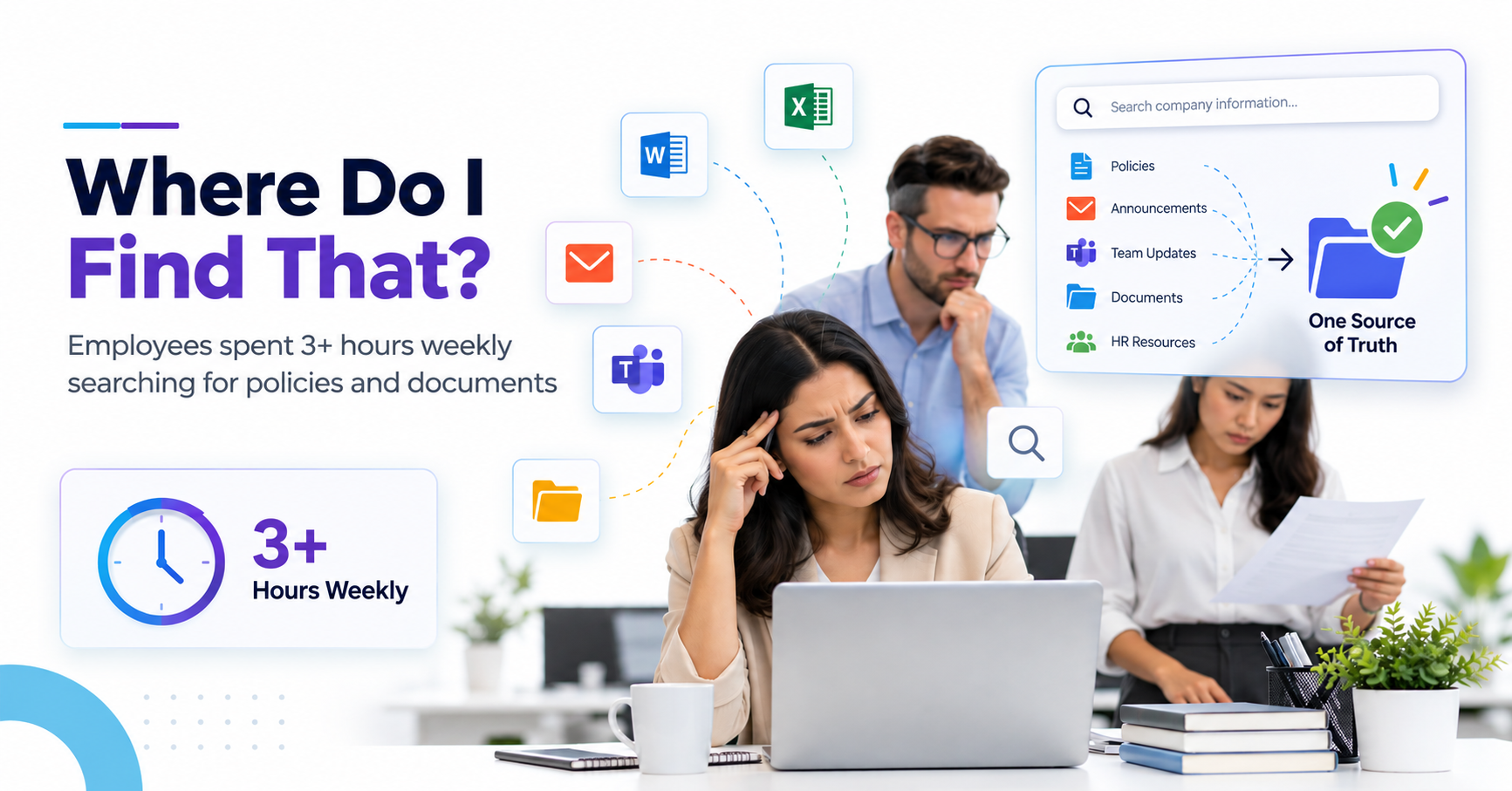
400+ employees searching across 12+ content locations, spending an average of 3.2 hours per week searching for company information
Client baseline assessment, pre-engagement
The Challenge
Information fragmentation was the core problem. Employees didn’t know where to find answers. New hires spent their first week asking “Where do I find the benefits guide?” or “Which Teams channel has the expense policy?” Long-tenured staff developed workarounds, bookmarking folders or saving email threads, but this approach didn’t scale and created silos of personal knowledge.
On top of that, the HR and communications teams had no centralized publishing mechanism. They pushed announcements into Teams, email, and sometimes separate channels, resulting in inconsistent messaging and redundant efforts. There was no version control for policies, no clear “single source of truth” for company documentation, and no way to track which employees had accessed critical information like compliance or safety updates.
The challenge got worse with distributed work. Remote and in-office staff experienced different discovery patterns. Some employees relied on overhearing conversations or asking colleagues; others missed announcements entirely because they weren’t in the right Teams channel or email thread. This created a knowledge divide that undermined company culture and operational consistency. Sound familiar?
- Employees spent 3+ hours weekly searching for company policies, benefits information, and procedural documents
- No single source of truth for HR resources, organizational structure, or department-specific guidelines
- HR and communications teams published to multiple channels simultaneously, leading to version confusion and redundant effort
- New hire onboarding lacked a structured knowledge resource, increasing time-to-productivity
- No searchable archive or audit trail for policy updates and compliance-related documents
64 minutes average daily time lost searching for company information across email, Teams, and shared folders
Employee survey, pre-engagement baseline
The Solution
AscenWork designed a comprehensive SharePoint employee intranet portal built on modern hub and communication site architecture. Here’s the thing: we weren’t just dumping documents into SharePoint. Instead, we engineered a user-centered information architecture that reflected how employees actually work, combined with intuitive navigation and powerful search capabilities.
Hub-Based Architecture and Navigation
We structured the intranet as a central hub connected to departmental communication sites. The hub served as the landing page and unified navigation layer, while each department (Engineering, Product, Sales, Marketing, Finance, HR, Operations) maintained a communication site for team-specific news, resources, and announcements.
This hub-and-spoke model achieved two critical things. First, it reduced cognitive load. Employees could navigate to their department’s area for specialized content while still accessing company-wide resources from the central hub. Second, it distributed content ownership. Departmental managers and team leads could publish and update their own content, reducing bottlenecks at the communications team level while maintaining brand consistency through shared templates and governance.
Navigation was designed mobile-first. We included a persistent top-bar menu with links to HR services, policies, organizational directory, and quick-access resources. A hierarchical left-navigation menu provided deeper drilling into department-specific areas. Search was prominently positioned on every page.
Content Organization and Publishing Workflow
We established five primary content zones within the central hub. The first, Company News and Announcements, displayed time-sensitive updates using a news web part with audience targeting. Employees saw only announcements relevant to their role or department. The second zone, HR and Benefits, surfaced policies, leave procedures, benefits guides, expense reports, and employee services in a logical, searchable structure.
The third zone, Departments and Teams, provided quick links to each department’s communication site, organizational chart, and team contact information. The fourth, Tools and Resources, housed templates, forms, budget trackers, and links to external systems like the benefits portal and expense management software. The fifth, Company Culture and Engagement, highlighted employee spotlights, upcoming events, wellness programs, and community announcements.
Worth noting: we configured a structured publishing workflow. Content owners submitted announcements or policy updates through a request form. A designated approver reviewed and published to the hub. This governance layer ensured accuracy, prevented outdated information, and created an audit trail for compliance purposes.
Search and Knowledge Discovery
Behind the scenes, we optimized the SharePoint search schema. We indexed all documents, policies, and news articles with meaningful metadata: content type, department, publication date, and audience. This allowed employees to search for “expense policy” or “onboarding” and instantly surface the most relevant result, whether it was stored in the hub, a departmental site, or a document library.
We also implemented highlighted content web parts on key landing pages. The HR page, for example, displayed the five most-requested resources based on usage analytics: the benefits guide, leave request form, org chart, payroll FAQs, and the employee handbook. This reduced the need to search for common queries.
Beyond SharePoint’s native search, we enabled audience targeting for news and announcements. HR could post a benefits update visible only to employees in a specific office location or tenure group. That personalized experience improved relevance and reduced information noise.
AscenWork Engineering Perspective
The critical design decision was resisting the temptation to build a complex, heavily customized solution. Modern SharePoint works best when you align with its native patterns: communication sites for publishing, hub sites for navigation, news web parts for content discovery, and built-in search with proper metadata. We avoided custom code and external tools, which meant the client could maintain and extend the intranet themselves using out-of-the-box features. This also ensured future Microsoft updates wouldn’t break critical functionality. Governance and audience targeting were the two technical levers we tuned carefully, because once you get those right, adoption follows naturally.
Implementation Approach
AscenWork deployed the SharePoint employee intranet portal through a structured, phased approach designed to minimize disruption and ensure adoption.
- Discovery and Information Audit: We conducted interviews with 25+ employees across all departments to map current information behaviors. We identified the top 15 questions employees asked repeatedly and the 12+ content locations they searched. This discovery informed our information architecture and search strategy.
- Information Architecture and Design: We created wireframes for the hub homepage, department site templates, and content zone layouts. We also validated designs with a cross-functional working group including HR, communications, IT, and department managers. This ensured the structure matched how teams actually worked.
- Hub and Site Configuration: We provisioned the central hub site, configured navigation, created audience targeting rules, and set up the news feed with filtering logic. We also created departmental communication site templates and provisioned initial sites for each department. The IT team linked department sites to the hub.
- Content Migration and Publishing Workflow Setup: We audited the client’s existing content, identified documents to migrate, and worked with department owners to organize and standardize resources. We also configured the request form and approval workflow, training designated approvers on the publishing process. This ensured governance was in place before launch.
- User Training and Adoption: We delivered training sessions for department managers, content approvers, and end users. We created quick-start guides, video tutorials, and a dedicated support channel in Teams. Beyond training, we launched with a week-long “Intranet Week” featuring daily tips, department takeovers, and a launch announcement from leadership.
What Made AscenWork’s Approach Different
Most agencies build a SharePoint intranet and hand it off. We invested heavily in discovery, involved end users in design decisions, and prioritized adoption mechanics like structured training and ongoing support. We treated the intranet as a change management initiative, not just a technology project. The result was a platform that employees wanted to use, not a tool they were forced to adopt.
Results and Impact
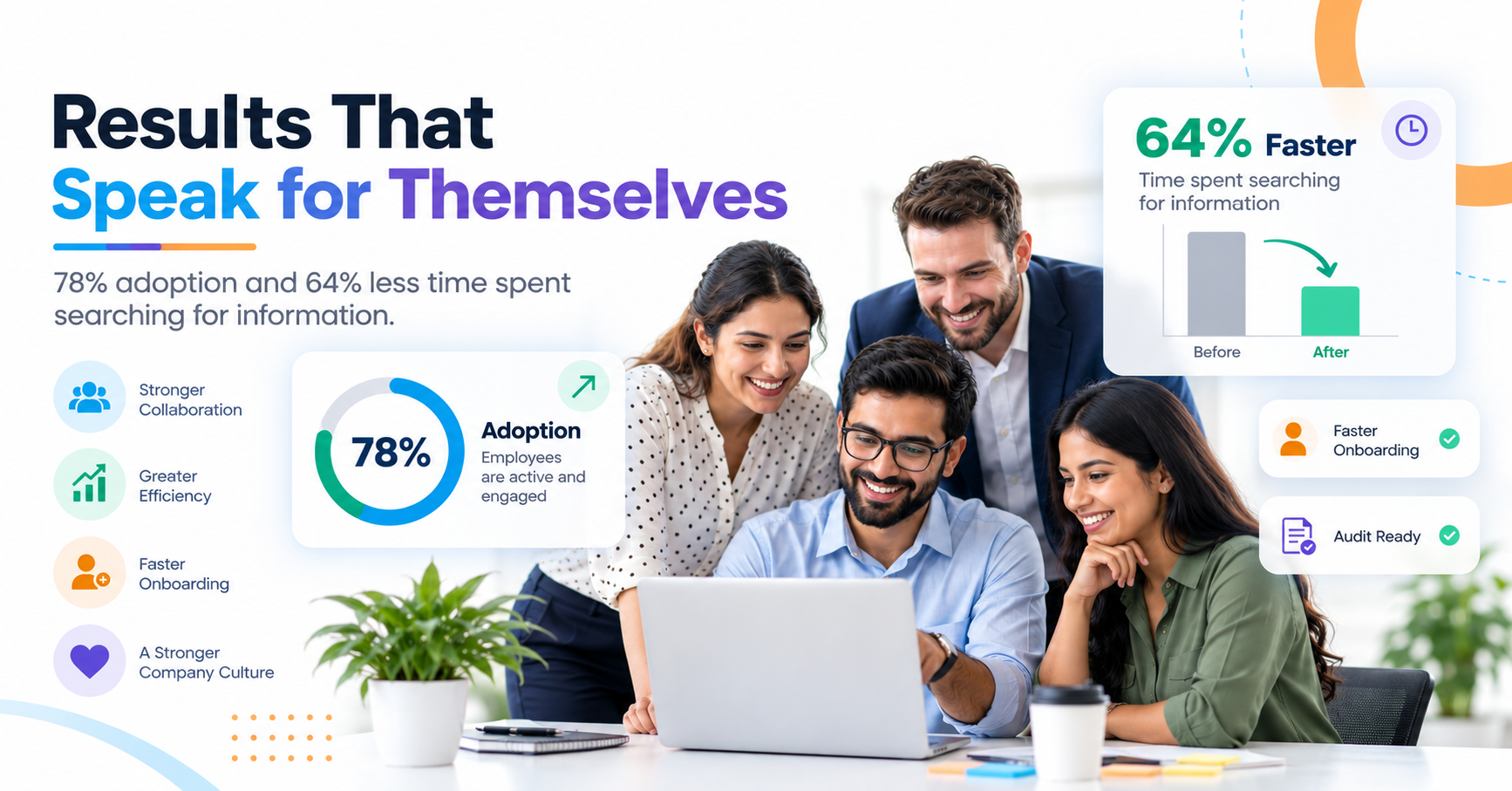
Within 90 days of launch, 78% of employees were actively using the intranet at least twice per week, and the time employees spent searching for company information dropped by 64%.
The impact extended beyond productivity gains. HR benefited significantly. Before, benefits questions flooded the HR inbox and Slack channel. Now, employees found answers themselves through the HR zone. Leave request forms were centralized, reducing processing errors and manual follow-ups. Policy updates were version-controlled and timestamped, creating a compliance audit trail that the finance team leveraged during their annual governance review.
Departmental communication improved dramatically. Engineering teams used their communication site to publish sprint updates and technical documentation. Sales updated deal resources and competitive intel. Marketing coordinated campaign announcements and brand assets. Each department owned their content, reducing the bottleneck at the central communications team. This distribution of responsibility actually improved publishing velocity and relevance.
And here’s the thing: new hire onboarding transformed. Instead of pointing new employees to a disorganized shared folder or email thread, HR now gave them a single link: the intranet. New hires completed onboarding faster, felt more informed about company culture, and reported higher confidence in knowing how to navigate organizational processes.
The intranet also became a strategic asset for company culture. The Company Culture and Engagement zone highlighted employee achievements, promoted wellness programs, and fostered a sense of community in a distributed workforce. Engagement metrics improved, as evidenced by higher participation in company events and wellness initiatives tracked through the intranet.
64% reduction in time employees spent searching for company information; adoption rate reached 78% within 90 days
Usage analytics and employee survey, post-launch
| Metric | Before AscenWork | After AscenWork |
|---|---|---|
| Time spent weekly searching for company information | 3+ hours per employee | 1.1 hours per employee |
| Content locations where employees searched | 12+ (email, Teams, folders, HR portal, etc.) | 1 (SharePoint intranet) |
| HR support tickets related to policies and benefits | 23 per week | 7 per week |
| Time to publish company announcements | 3-5 days (multiple channels) | 1 day (single hub) |
| New hire onboarding completion time | 7-10 days | 3-4 days |
| Active intranet users (weekly) | 0% (no intranet existed) | 78% |
Key Lessons and Takeaways
Lesson 1: Information Architecture Comes Before Technology
The most common intranet failure we observe happens when companies provision SharePoint sites without first mapping how employees work and what information they actually need. This client succeeded because we spent two weeks understanding their information behaviors before building anything. We interviewed frontline employees, observed how Teams was used, and audited all their scattered content. Only then did we design the architecture. The technical implementation was straightforward; the hard part was getting the structure right.
Lesson 2: Distributed Content Ownership Scales Better Than Centralized Publishing
Centralizing everything at the communications team creates a bottleneck. We’ve seen this consistently in our work with clients. By empowering department managers to publish on their own communication sites, we reduced publishing delays from days to hours. Content became fresher and more relevant. The key was providing templates, governance guardrails, and training so departments didn’t create chaotic inconsistency. A light-touch governance approach, approval for company-wide news, self-publishing for departmental updates, worked better than heavy-handed control.
Lesson 3: Search and Discoverability Are Underestimated
Many intranet projects focus on content structure and navigation. They miss the fact that employees often search first, browse second. We optimized the search schema aggressively: meaningful metadata, synonym mapping, and result ranking by relevance. After launch, we analyzed search queries and discovered that employees wanted to find “expense form,” “leave policy,” and “onboarding checklist.” We surfaced these through highlighted content web parts on relevant landing pages, reducing reliance on search for common queries. This small adjustment drove adoption significantly.
Lesson 4: Adoption Requires Leadership Sponsorship and Change Management
Technology alone doesn’t drive adoption. The CEO endorsed the intranet at launch, sent a company-wide email encouraging usage, and highlighted it in their town hall. Department heads did the same with their teams. We facilitated this by providing leadership messaging templates and explaining the business case. Without this sponsorship, the intranet would’ve been another tool employees ignored. With it, adoption hit 78% in 90 days.
What This Means for SaaS Companies
Most SaaS companies face the same challenge this client did: rapid growth outpaces internal infrastructure. By the time you realize information is fragmented across email, Teams, and a dozen shared folders, you’ve already created cultural and operational friction. New hires struggle. HR drowns in repetitive questions. Leadership can’t enforce policy consistency. A centralized SharePoint employee intranet portal solves this without requiring new software licenses or complex integrations. You likely already have SharePoint through Microsoft 365.
For SaaS companies specifically, the ROI is high. Every hour employees don’t spend searching for company information is an hour available for customer delivery, product development, or sales activities. More subtly, a well-designed intranet becomes a strategic tool for company culture, particularly for distributed or hybrid teams. It’s a visible, tangible expression of company values and operational discipline. As you scale from 100 to 500 to 1000 employees, having a single source of truth for policies, benefits, and organizational information becomes table stakes. Building it early, when organizational processes are still malleable, is far easier than retrofitting governance into a fragmented system.
Additionally, many SaaS companies struggle to track which employees have reviewed critical compliance, security, or safety information. A SharePoint intranet with access logs and content versioning provides an audit trail. You can confirm that all employees reviewed the latest anti-harassment policy or security protocols. This matters when regulators ask questions or litigation risk rises.
Ready to Centralize Your Employee Communications?
A SharePoint employee intranet portal transforms how your team accesses company information and collaborates across departments. AscenWork guides SaaS companies through discovery, design, implementation, and adoption, ensuring your intranet becomes a cultural tool, not just a repository. Let’s discuss how we can reduce information friction and accelerate your team’s productivity.