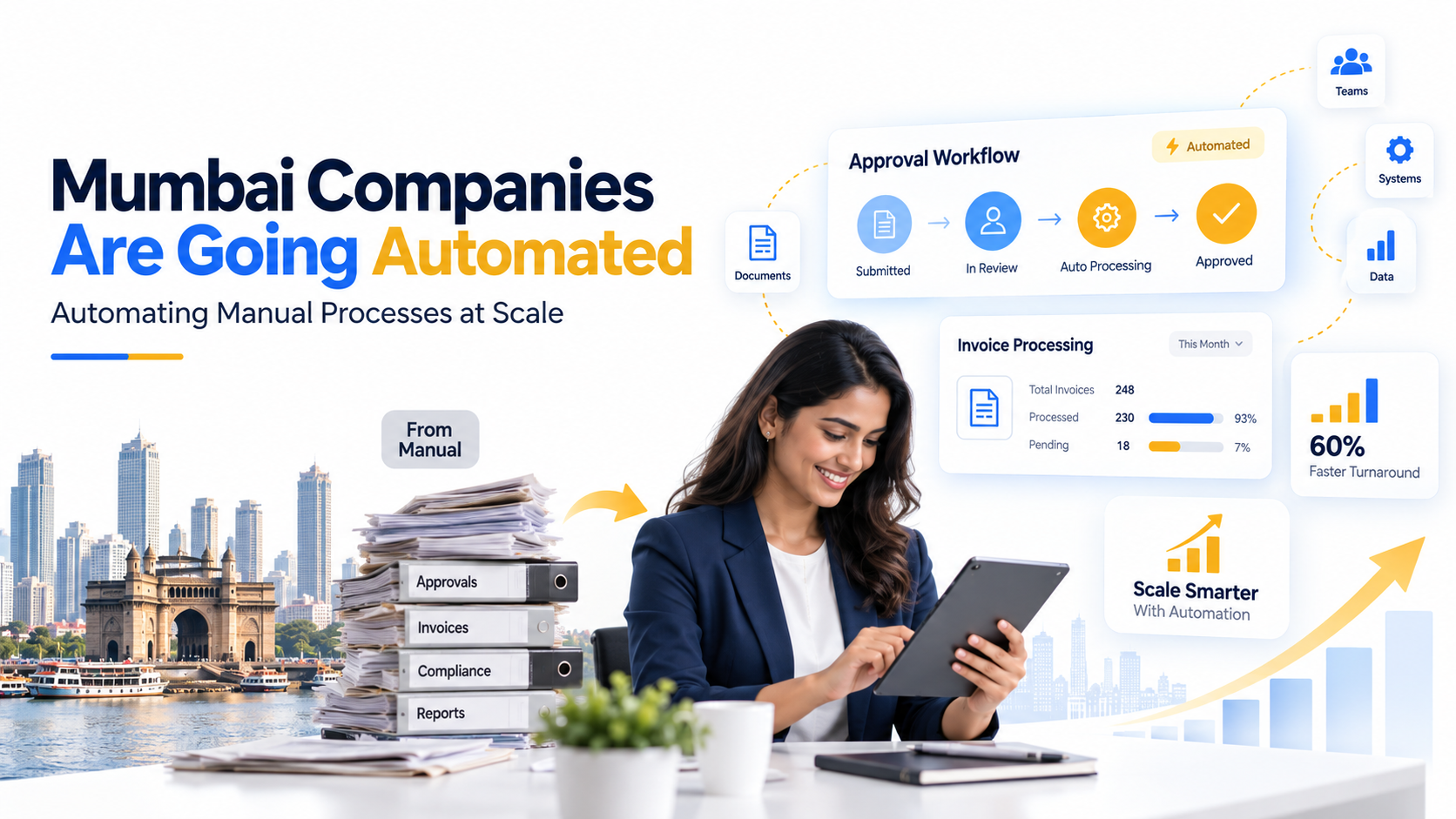
How Fast-Growing Mumbai Companies Are Automating Manual Processes to Keep Up With Scale
Workflow automation in Mumbai isn’t a nice-to-have anymore, it’s a competitive necessity. Your team’s drowning in approvals. Invoices sit in inboxes for days. Compliance reporting means pulling data from five different systems. Sound familiar? This is the silent killer of fast-growing workflow automation Mumbai, and it’s entirely solvable.
Key Takeaway
Growing companies lose 25 to 40% of operational capacity to manual, repetitive tasks. The right workflow automation solution unlocks that capacity instantly so your team can focus on strategic work instead of data entry.
In This Article

Why Manual Processes Break Down as Companies Scale
India’s startup and SMB growth rate has accelerated dramatically over the past three years. But here’s what nobody talks about: operational debt is now the number-one hidden cost killing profitability. In Mumbai’s competitive business environment, teams that can move faster win contracts, retain talent, and scale without hiring proportionally.
When you’ve got 20 people, manual processes are slow but survivable. Spreadsheets work. Email approvals get through. But at 50 people, 100 people, or beyond, something breaks. The systems that got you to scale become the very thing that prevents further scaling.
Consider what happens to an invoice when it arrives. It lands in an inbox. It waits for an approval. That approval depends on a busy finance head who’s managing dozens of other tasks workflow automation Mumbai. It bounces back for clarification. It sits again. Days pass. The vendor doesn’t get paid on time. Cash flow suffers. Your vendor relationships suffer. Your team’s morale suffers because they’re chasing status updates instead of driving growth.
According to research from NASSCOM, operational efficiency is the third-highest priority for growing Indian enterprises, yet 67% of SMBs still rely on manual processes for critical workflows.
NASSCOM Digital Transformation Report, 2024
This isn’t a minor inconvenience. At scale, it’s a strategic bottleneck. Workflow automation in Mumbai is the way forward because it removes these friction points before they become organizational constraints.
The Real Cost of Not Automating
Most growing companies don’t realize how much manual work is actually costing them. Here’s what happens when you don’t implement workflow automation:
- Invoice and PO approvals stuck in email threads: Vendor payments delay. Cash flow reporting becomes a guessing game. Relationships with suppliers deteriorate.
- Manual data re-entry across systems: Your finance team enters the same invoice details into the ERP, the accounting software, and a spreadsheet. Errors multiply. Month-end reconciliation becomes a nightmare.
- No real-time visibility into project status or resource allocation: When clients call asking for updates, your project managers have to ask around. Decisions get delayed. Client satisfaction drops.
- Month-end closing takes 2 to 3 weeks: Because everything lives in spreadsheets and scattered emails, pulling accurate financial data requires manual compilation and verification from every department.
- Employee frustration and turnover: Your best talent didn’t join your company to do data-entry work. When talented people spend half their week on repetitive manual tasks, they leave for companies that value their expertise.
- Audit and compliance exposure: Manual processes mean inconsistent documentation. When the GST authority or an auditor asks to see your approval trail, you’re scrambling to reconstruct it from emails and loose notes.
Each week of delay in approvals directly impacts cash flow. Client relationships suffer. Audit risk accumulates. At scale, this becomes a blocker to hiring, expansion, and profitability.
The alternative is workflow automation. Not as a nice-to-have, but as a core operational capability.

The Solution: Workflow Automation for Growing Companies
Workflow automation in Mumbai solutions work by taking the manual, repeatable parts of your business processes and automating them. Here’s how it looks in practice:
Automate invoice-to-payment workflows: When an invoice arrives, it’s automatically routed to the correct approver based on amount, vendor, and department. Conditional logic handles exceptions. Notifications remind approvers of pending items. No email chains. No manual routing.
Create a single source of truth: All documents, project files, and metadata live in SharePoint. When someone needs an approved vendor contract, they find it in seconds instead of asking around. Version control prevents people from working on outdated documents.
Trigger automatic notifications and reminders: If an approval is pending for more than two days, the system automatically reminds the approver. If a shipment is delayed, relevant teams are notified without anyone manually checking status reports.
Generate compliance reports instantly: Instead of spending a week pulling data from multiple systems, audit-ready reports generate on-demand with full audit trails built in. Your GST filing, compliance submissions, and internal audits become frictionless.
Reduce manual data entry by 60 to 80%: When your ERP system, accounting software, and document management tool are connected, information flows automatically. No re-keying. No errors from manual transcription.
Expert Perspective
The best workflow automation strategy targets processes that are repeatable, high-volume, and low-variation. Not every process should be automated. A good partner helps you identify which workflows will deliver the highest return and which ones still require human judgment. The goal isn’t to automate everything, it’s to automate the right things so humans can focus on decisions that matter.
When choosing a partner for workflow automation, look for three things. First, they understand your industry and India-specific compliance requirements (GST, labor regulations, audit expectations). Second, they have deep expertise in modern platforms like SharePoint and Power Automate, not legacy integration tools. Third, they invest in change management and training, not just technical implementation.
Why Leading Mumbai Businesses Choose AscenWork for Workflow Automation
AscenWork stands apart in the workflow automation Mumbai landscape because we combine local expertise with global best practices. Here’s how we compare:
| Factor | AscenWork | Generic/DIY Tools | Local IT Vendor |
|---|---|---|---|
| Industry Know-How | Deep expertise in Indian compliance (GST, labor law, audit requirements) and modern SharePoint architecture | Generic templates that miss Mumbai-specific regulations and local business context | Limited to their past projects; may lack depth in workflow automation and modern platforms |
| Implementation Speed | Proven methodology with quick wins first; dedicated team focuses on your success | Slow learning curve; requires your team to understand the platform deeply before seeing results | Can be slow; depends on vendor bandwidth and availability of the right skill set |
| Ongoing Optimization | Dedicated success team proactively monitors workflows and suggests improvements as your business evolves | Community forums provide reactive help; you figure out best practices on your own | Hit-or-miss support; dependent on a single vendor contact who may leave or become unavailable |
| Integration Capability | Seamlessly connects with Tally, SAP, QuickBooks, and other systems common in Indian SMBs | Limited integration options; often forces you to change existing systems | May require expensive custom coding for integrations not in their standard toolkit |
AscenWork’s approach combines local and global perspective. We understand Mumbai’s business ecosystem, India-specific regulatory landscape, and the unique challenges fast-growing companies face. We also bring global best practices from workflow automation frameworks used by enterprises worldwide.
Our SharePoint mastery means we design workflows that scale with your company. Unlike point solutions that need replacement every 18 months, a well-architected SharePoint environment grows with you. We don’t just hand off software, either. We train your team and guide adoption so the automation actually gets used by everyone, not just the tech-savvy folks.
Real-World Automation Wins Across Mumbai Industries
Finance and Accounting
The challenge: Expense reports and vendor invoices require five or more manual approvals. Month-end close is chaotic because data lives in spreadsheets and emails. Reconciliation takes weeks.
The solution: Automatically route invoices based on amount and vendor category. Flagged exceptions get human attention; everything else flows through. GL reports generate instantly.
The outcome: Close in five days instead of three weeks. Zero coding errors. Auditors see a complete, automated trail of every approval and decision.
Logistics and Supply Chain
The challenge: Shipment status updates are manually logged by different teams. Visibility is poor. Compliance documents are scattered across folders and email threads.
The solution: Automatically log shipment data from carrier APIs. Trigger alerts when shipments are delayed. Centralize all compliance documents in SharePoint with version control.
The outcome: Exception handling is 40% faster. Regulatory submissions are audit-ready. No lost or outdated documents.
Healthcare and Pharma
The challenge: Approvals for new clinical protocols, regulatory submissions, and procurement are severe bottlenecks. An outdated document accidentally gets used, causing compliance violations.
The solution: Automated approval workflows with role-based visibility. All documents are version-controlled in SharePoint. Change tracking is automatic.
The outcome: Regulatory submissions happen faster. No lost or outdated protocols. Compliance audits are straightforward because the audit trail is automatically maintained.
Retail and E-Commerce
The challenge: Order fulfillment, inventory synchronization across channels, and vendor communications are fragmented. Stockouts happen because inventory data isn’t real-time.
The solution: Automatically sync inventory across channels. Trigger vendor reorder requests when stock hits a threshold. Centralize all vendor communications in a single channel.
The outcome: Stockouts reduce significantly. Restocking happens faster. Vendor relationships improve because communication is clear and centralized.
How to Get Started With Workflow Automation
Implementing workflow automation doesn’t require overhauling your entire operation. Here’s a proven, step-by-step approach:
- Process Discovery and Mapping: Identify two to three manual workflows that are high-volume, high-pain, and repeatable. Document how each workflow currently works, who touches it, and where delays happen. You’ll gain a clear understanding of where the biggest wins are and build a roadmap for phased implementation.
- Design and Proof of Concept: Build a prototype workflow in your test environment. Run it with a small team for two to three weeks. Gather feedback from end-users and refine the design. You’ll gain confidence that the solution works before rolling out to the entire organization.
- Deploy With Training: Roll out to your full team. Run training sessions so everyone understands how the new workflow works. Establish governance rules, who can approve, what happens if something breaks, how exceptions get escalated. Your team will adopt the new process more readily when they understand the why and the how.
- Monitor and Optimize: Track workflow performance. Gather feedback from users. Refine rules based on edge cases that weren’t caught during the pilot. Workflows improve over time as you see how people actually use them in real scenarios.
- Scale to Other Processes: Apply the learnings and automation principles you’ve discovered to your next batch of workflows. The second and third automation projects move faster because you’ve already solved the cultural and technical challenges.
This approach minimizes disruption and builds momentum. You see quick wins early. Your team gains confidence in the new system. Then you expand from there.
Frequently Asked Questions
How long does it take to automate a workflow?
Timeline depends on complexity and your environment readiness. Simple approval workflows can progress quickly. Complex workflows with multiple system integrations take longer. A good partner creates quick wins first to build momentum, then tackles more complex automations. During your discovery call, we assess your specific situation and provide a realistic roadmap.
Do we need to replace our existing systems to use workflow automation?
No. Modern automation tools like Power Automate integrate with your existing ERP, CRM, or accounting software. You keep your systems and add automation on top. This is far more cost-effective and less disruptive than ripping and replacing everything.
What if our processes are different across departments?
Workflow automation is flexible. A single SharePoint plus automation setup can handle different rules for Finance, HR, Operations, and other departments. That’s actually one of the big advantages. You get consistency and control while accommodating legitimate process differences.
How do we know if a process is automatable?
If it’s repeatable, high-volume, and involves minimal human judgment (or judgment can be coded as rules), it’s a candidate. Workflows that require subjective decisions from a domain expert are less suitable. A good partner conducts a free assessment to identify your best automation opportunities and prioritize them.
What happens if something goes wrong in an automated workflow?
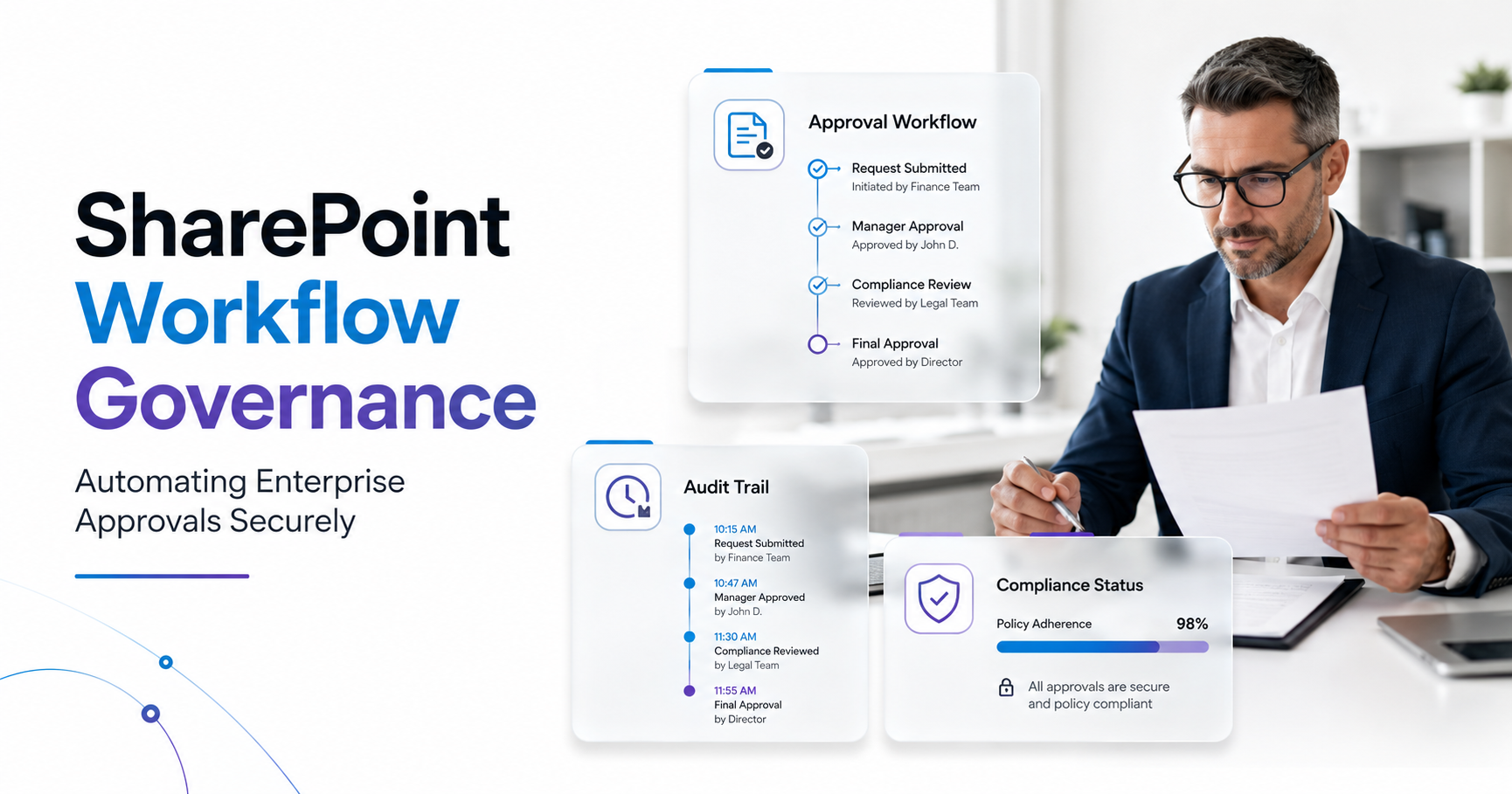
Workflows include error-handling and escalation paths. If something breaks, the system notifies the right person immediately. There’s also a complete audit trail so you can see exactly what happened and why. Nothing gets lost or silently fails.
Ready to Unlock Your Team’s Capacity?
Fast-growing Mumbai companies can’t afford to waste 30 to 40% of their team’s capacity on manual work. Workflow automation gives you visibility, control, and speed so your team focuses on growth instead of bottlenecks. Let’s explore which of your workflows could be automated first.