How to Stop Vendor and Purchase Approvals Getting Stuck in Email
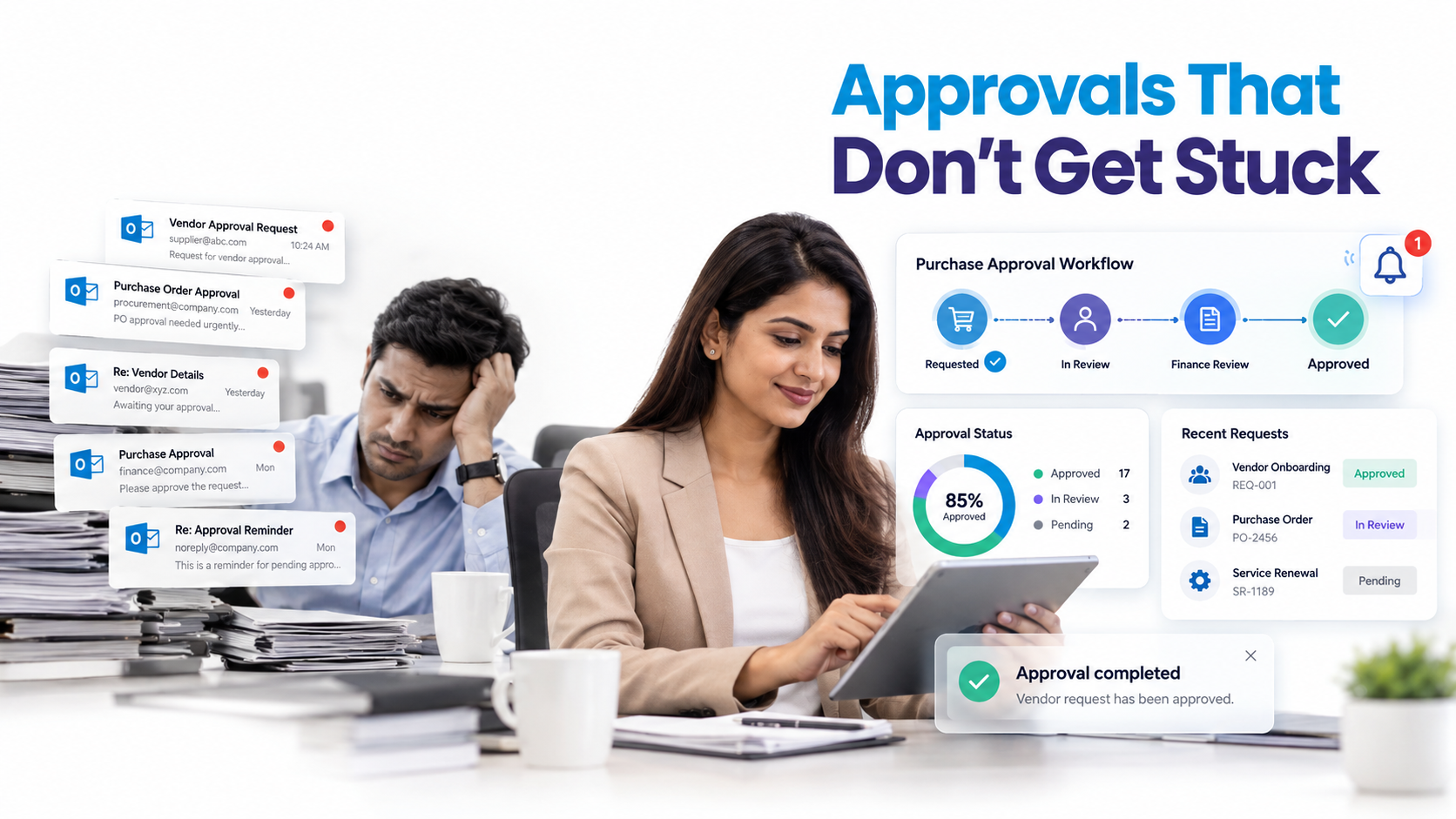
Procurement approval delays happen to almost every mid-market and enterprise business, and they’re costing you more than you realize. Your finance director approves a $50K vendor contract. It reaches the CFO’s inbox but gets buried under 200 other emails. Two weeks later, you’re chasing down sign-off. Meanwhile, your procurement team is re-sending approval requests, and no one knows where the bottleneck is. Procurement approval delays don’t just slow down deals, they delay project starts, cost you early-pay discounts, and create compliance gaps that auditors flag during reviews.
Key Takeaway
Procurement approval delays are almost entirely preventable with the right workflow approach. Email-based vendor approvals lack visibility, scalability, and audit trails, but modern approval workflow automation solves all three.
In This Article
- Why Procurement Approval Delays Cost More Than Time
- The Core Challenge: Why Email-Based Vendor Approvals Fail
- The Solution: Automated Vendor Approval Workflow
- Why Leading Procurement Teams Choose Workflow Automation
- Industry Applications: Procurement Workflows in Action
- How to Get Started With Vendor Approval Automation
- Frequently Asked Questions
Why Procurement Approval Delays Cost More Than Time
Procurement approval delays aren’t just an inconvenience, they’ve got real business consequences. According to a McKinsey analysis of procurement digital transformation, organizations that rely heavily on manual, email-based approval workflows report approval cycle times that are 40-50% longer than those using automated systems. That’s not a small difference.
When approvals get stuck, vendor contracts delay. Project timelines slip. Budget cycles misalign. Your team burns cycles chasing approvers instead of managing vendor relationships. On top of that, email-based approvals create compliance exposure. Auditors struggle to trace approval authority, decision dates, and the reasoning behind purchase decisions. This gets especially risky when you’re handling regulated purchases, healthcare, finance, government contracting.
“Organizations that automate procurement approvals see median approval cycle time improvements of 35-50%, depending on process complexity and stakeholder coordination.”
Deloitte Global Procurement Survey, 2024
The ripple effects are real. Missed early-pay discounts compound into millions annually for large procurement teams. Delayed vendor onboarding means losing competitive suppliers. Compliance audit findings create remediation work that procurement didn’t anticipate. And here’s the thing: your procurement managers spend 15-25% of their week on approval logistics, tracking emails, sending reminders, escalating stalled decisions. That’s time not spent on strategic vendor management.
The Core Challenge: Why Email-Based Vendor Approvals Fail
Email feels simple. It’s familiar. Everyone’s got an inbox. So why do approval workflows built on email become such a bottleneck as your business scales?
The problem isn’t email itself, it’s that email was designed for communication, not process management. Here’s what happens in practice:
- No single source of truth. Approvals scatter across multiple inboxes, forwarded threads, and archived messages. When someone asks “Where is that vendor contract?”, nobody knows if it’s with the CFO, the controller, or stuck in someone’s “Follow Up” folder.
- Zero visibility into approval status. Your team can’t see who should approve next, how long approvals have been pending, or which stakeholder’s the bottleneck. They resort to checking in manually, “Can you approve this?”, taking time away from the approver’s real work.
- Manual reminders and re-sends waste staff time. Procurement coordinators spend hours re-sending approval requests, following up with busy executives, and escalating stalled decisions. This is administrative work that adds no value.
- Compliance and audit trail gaps. Email approvals create a fragmented record. There’s no immutable timestamp, no clear chain of authority, and no audit log showing who approved what or on what basis. When compliance or audit teams need to verify purchase authority, the evidence is scattered and incomplete.
- Difficult scaling as volume and complexity grow. When you add a new business unit, new approval thresholds, or new compliance rules, managing those changes across email-based workflows is error-prone. You’re relying on people remembering the rules, which they don’t.
- Risk of approvals slipping through cracks during transitions. When an approver goes on vacation or leaves the organization, their approval responsibilities disappear. There’s no system reassigning the work or escalating it. Deals get stuck indefinitely.
The consequence is cascading delay. Procurement sends a purchase requisition. Finance approves it three days later. That approval goes to the CFO, who doesn’t see it for a week. The CFO approves it, but the message gets buried in the controller’s inbox. Now the deal is 10 days behind before any real work happens. For seasonal procurement spikes or large vendor contract negotiations, these delays multiply across dozens of concurrent approvals.
The Solution: Automated Vendor Approval Workflow
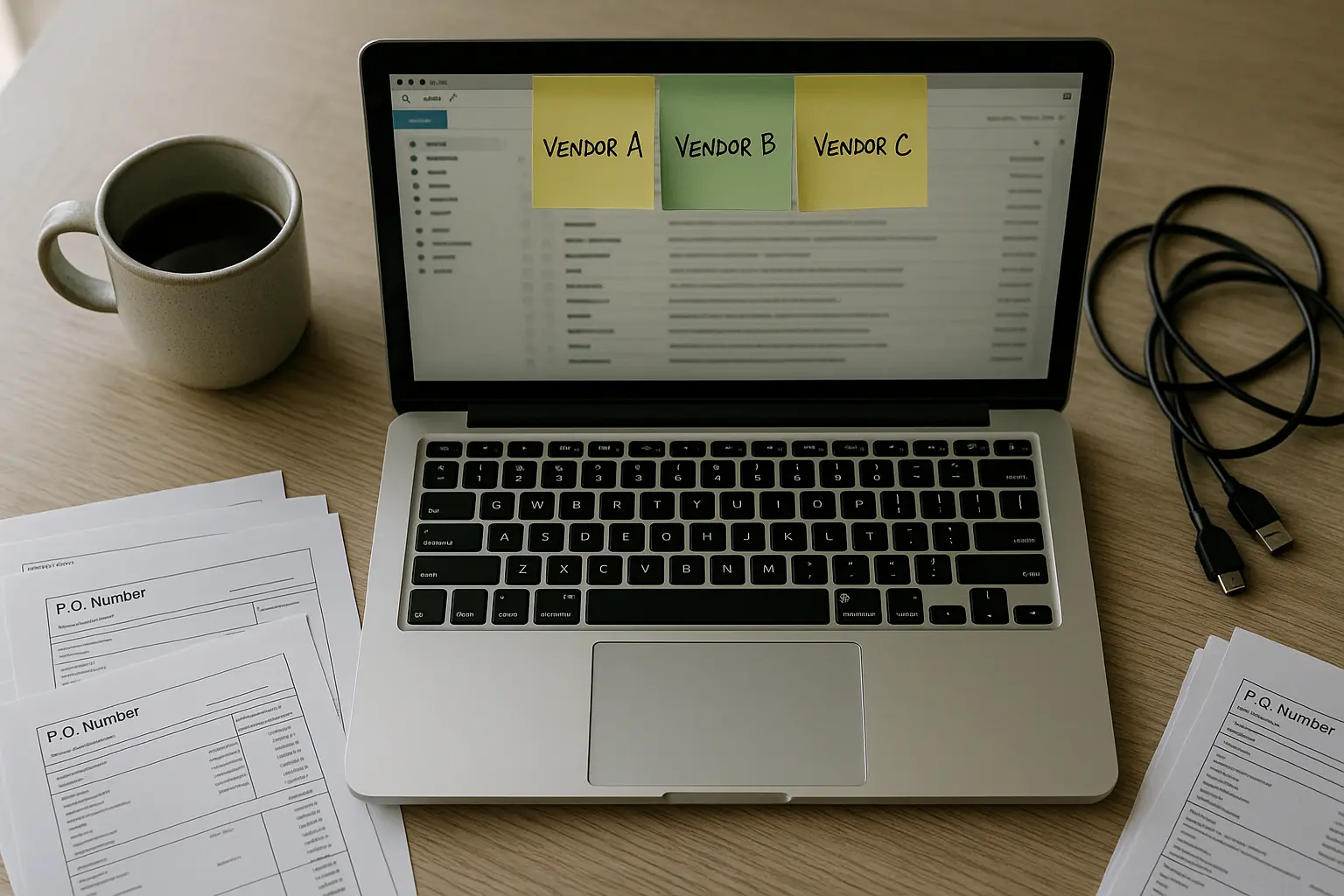
Procurement approval delays exist because email lacks process controls. Modern approval workflow automation solves this by replacing fragmented email threads with a centralized, rule-driven system. And here’s the thing: this isn’t about removing humans from approval decisions. It’s about removing the administrative overhead of routing, tracking, and reminding.
Here’s how automated vendor approval workflow addresses each pain point:
- Centralized approval dashboard replaces fragmented email threads. All pending approvals appear in one place. Approvers see exactly what needs their attention, in what order, and how long it’s been waiting. No more digging through email.
- Real-time status visibility and automatic escalation rules. Your procurement team can see an approval in progress in seconds, not hours. If an approval hasn’t moved in 24 hours, the system automatically reminds the approver or escalates to their manager. No manual chasing required.
- Audit trail and compliance documentation built in. Every approval creates an immutable record: who approved, when, on what date, and from what IP device. This record’s available for internal audit, compliance review, and external auditors without manual reconstruction.
- Approval routing based on amount, vendor type, or department rules. Define custom rules once: purchases under $10K skip the CFO; new vendors require compliance sign-off; international purchases need legal review. The system enforces these rules consistently across all approvals.
- Mobile access so approvers can act from anywhere. Busy executives don’t have to wait until they’re back at their desk. They can approve from a phone, tablet, or any device. This dramatically shortens approval cycles.
- Automatic integration with ERP and accounting systems. Once approved, the purchase order automatically flows to your accounting system. No manual data re-entry, no transcription errors.
Expert Perspective
The key isn’t removing humans from approval decisions, it’s removing the administrative overhead of routing, tracking, and reminding. Approvers focus entirely on the decision, not the logistics. This shift cuts approval cycle time dramatically while actually strengthening governance because rules are enforced consistently, not subject to how busy someone is that day.
What to look for in an approval workflow partner: integration capability with your existing ERP, accounting, or procurement system; configurability so you can define custom approval rules without coding; compliance certifications and audit-ready reporting; and dedicated implementation support to ensure your team adopts the new process. The best platforms learn from your workflows and suggest optimizations, not just automate what you already do.
Why Leading Procurement Teams Choose Workflow Automation
To understand why procurement teams migrate away from email-based approvals, it helps to compare the approaches side by side:
| Feature | Email-Based Approvals | Modern Workflow Automation |
|---|---|---|
| Real-time visibility into approval status | ❌ Manual checking only | ✅ Dashboard, instant view |
| Automatic escalation and reminders | ❌ Manual follow-up | ✅ Rules-based, no manual effort |
| Audit-ready approval trail | ❌ Fragmented, manual reconstruction | ✅ Immutable, exportable records |
| Configurable approval rules by amount or type | ❌ Relies on people remembering | ✅ Enforced automatically |
| Mobile approver access | ✅ Via email (limited) | ✅ Full mobile app or web |
| Reduced manual follow-up time | ❌ High admin burden | ✅ Minimal manual intervention |
| Integration with ERP and accounting systems | ❌ Manual data entry | ✅ Automatic data flow |
The three differentiating factors that matter most: First, speed through automation, not shortcuts. Modern workflow automation reduces cycle time while enforcing governance. You’re not sacrificing control for speed. Second, compliance by design. Audit trails and role-based access controls are built in from day one, not bolted on later. Third, scalability without complexity. As your business grows, approval workflows scale effortlessly. New vendors, new thresholds, new regulatory requirements, the system adjusts. Email-based workflows become exponentially more chaotic at scale.
Leading procurement teams also report that workflow automation improves cross-departmental collaboration. Finance, procurement, and legal can all be involved in approvals without creating communication bottlenecks. Everyone sees the same status, same documents, same decision points. This transparency builds trust and accelerates approvals.
Industry Applications: Procurement Workflows in Action
Finance and Banking
Financial institutions handle dozens of vendor contracts monthly, each requiring multi-level approval across procurement, compliance, and executive teams. Workflow automation routes vendor contracts to the right approvers based on contract value, currency, and counterparty risk. If a contract from a new vendor over $500K needs approval, the system automatically flags it for compliance review and legal sign-off before executive approval. This eliminates email chains and ensures no contract slips through without proper vetting.
Healthcare and Life Sciences
Healthcare organizations must qualify vendors for medical supplies and pharmaceuticals, a process requiring approval from procurement, clinical operations, and regulatory compliance. Procurement approval workflow automation manages this complexity by routing requisitions based on product category and risk level. Emergency supplies bypass some approvals; new drug suppliers require additional compliance documentation. The system enforces these distinctions consistently across all approvals, reducing the risk of non-compliant purchases.
Retail and E-Commerce
Retail businesses launch seasonal product lines at scale, requiring rapid vendor onboarding and approval across dozens of concurrent purchases. Manual approval processes become bottlenecks during peak seasons. Workflow automation handles the volume by routing approvals by department, geography, and vendor status. New vendors go through full vetting; returning vendors get expedited approval. This balance speeds time-to-market while maintaining quality controls.
Manufacturing and Logistics
Manufacturing companies must coordinate vendor approvals across multiple plants, supply chain partners, and geographies. A long-lead-item purchase at Plant A requires approval from supply chain, operations, and the plant manager. Workflow automation routes approvals to the correct plant and stakeholder combination without manual coordination. When a supply chain disruption requires expedited approval, managers can escalate or override the standard routing rule without breaking the system.
How to Get Started With Vendor Approval Workflow Automation
Implementing procurement approval workflow automation doesn’t require a complete overhaul. Follow these steps to build momentum and deliver measurable improvements:
- Map your current approval process. Document who approves what, at what thresholds, in what order. Where do delays happen most frequently? Are certain approvers consistently the bottleneck? This baseline is your target for improvement. Outcome: clear understanding of your as-is state and opportunities for optimization.
- Define approval rules and escalation paths. Establish decision criteria: What triggers a compliance review? At what amount does the CFO get involved? How long should an approval wait before escalating? Write these rules down as they’ll form the configuration for your new system. Outcome: reduction in approval cycle time and bottleneck risk because rules are enforced consistently.
- Choose a system that integrates with your existing tools. Ensure it connects to your ERP, accounting system, or supplier management platform so data flows automatically. A workflow system that doesn’t integrate becomes a shadow system. Users still have to re-enter data, which they’ll avoid. Outcome: less manual data entry, fewer errors, faster approvals.
- Pilot with one approval workflow. Start with a single approval type, new vendor onboarding, for example, before rolling out organization-wide. This limits risk and lets you learn before scaling. Outcome: early wins, stakeholder buy-in, and lessons learned before full rollout.
- Train approvers and measure results. Make it clear where to find approval requests and what’s expected of them. Track cycle time and approval accuracy before and after implementation. Share wins with leadership. Outcome: faster adoption, sustained performance improvement, and a case for expanding the system to other approval types.
One important note: procurement approval workflow automation works best when paired with clear approval policies. If your organization doesn’t have agreed-upon thresholds, approval authority, or escalation rules, the system will expose those gaps. Take time upfront to define your policies. The workflow automation then enforces them consistently, which is its real power.

Frequently Asked Questions
How long does it take to implement a procurement approval workflow system?
Implementation speed depends on your organization’s complexity, the number of approval workflows you need to configure, and the depth of integration required with existing systems. Most organizations see a working system in place relatively quickly after starting configuration. Full rollout and optimization typically requires more time as you expand to additional approval types and refine rules based on real usage. The best approach is starting small, one approval workflow, and scaling based on early results and team feedback.
Can workflow software handle multi-currency and multi-location approvals?
Yes. Modern approval workflow systems are designed to handle complex approval scenarios across different locations, currencies, and business units. You can set approval thresholds based on local requirements, automatically convert between currencies, or apply regulatory rules specific to each region. For example, a $100K purchase in one country might require different approvals than the same amount in another country due to local regulations or company policy.
What if our approval process is unique or non-standard?
That’s actually common. The best workflow systems are highly configurable, allowing you to define custom approval rules, routing logic, and escalation paths without requiring custom code. If your process is truly distinctive, look for systems with strong implementation support to help you balance efficiency improvements with your unique governance requirements. Sometimes the system implementation forces useful conversations about whether your process really needs to be that complex.
How do we ensure compliance and audit readiness with digital approvals?
Workflow systems create an immutable audit trail showing who approved what, when, and on what basis. This trail supports SOX compliance, internal control testing, and financial audits directly. Ensure your system has role-based access control, approval rule documentation that’s exportable, and the ability to generate compliance reports on demand. Digital approvals actually strengthen compliance compared to email-based approvals because the documentation is systematic and permanent.
What’s the difference between a workflow system and just using email with better practices?
Email with better organizational practices will improve things slightly, but it doesn’t scale and lacks built-in safeguards. A workflow system centralizes all approvals in one place, automates routing and reminders, enforces approval rules consistently across your organization, and creates a compliance-ready audit trail automatically. Email requires people to remember rules and follow processes perfectly. Workflow systems remove that human dependency. Even the most disciplined teams can’t match the consistency and audit capability of a proper workflow system.
Stop Chasing Approvers, Start Automating Them
Your procurement team has better things to do than track emails and chase down approvers. Workflow automation puts vendor approvals on a predictable timeline, gives you complete visibility, and builds the audit trail compliance teams need. Let’s explore how other procurement leaders eliminated approval delays and scaled their processes.