Quality Control Documentation Errors: Why Compliance Failures Happen & How to Stop Them
Manufacturing quality control documentation errors are quietly costing factories millions in compliance failures every year. A single missing signature on a test certificate, an illegible entry in an inspection log, or a misfiled batch record can trigger FDA warning letters, customer audits failures, and costly recalls. The honest answer is that outdated documentation systems don’t just invite errors, they make them inevitable, undetectable, and nearly impossible to defend during regulatory inspections.
Key Takeaway
Manufacturing quality control documentation errors cascade silently until an audit reveals gaps that could’ve cost you weeks to fix. A centralized, auditable system transforms documentation from a compliance liability into a competitive advantage.
In This Article
- Why This Matters in Modern Manufacturing
- The Core Challenge: Why Documentation Errors Happen on the Factory Floor
- The Solution: A Centralized Manufacturing DMS for QC Compliance
- Why Leading Manufacturers Choose a Purpose-Built QC DMS
- Real-World Applications Across Manufacturing Sectors
- How to Get Started: A Phased Approach
- Frequently Asked Questions
Why This Matters in Modern Manufacturing
Manufacturing quality control documentation isn’t optional anymore. It’s a regulatory expectation that separates compliant operations from those facing warning letters. The FDA’s inspection database reveals something stark: documentation deficiencies show up in over 40% of warning letters issued to manufacturers. Often they’re cited as the root cause of entire compliance failures.
The manufacturing landscape has shifted dramatically over the past decade. Customer audits have intensified. Regulatory timelines have compressed. Second and third-party inspections happen more frequently, and auditors expect digital proof of compliance, not paper trails. A factory that still relies on handwritten inspection logs, spreadsheet-based test results, or file cabinets full of batch records is essentially operating on borrowed time.
“Documentation deficiency is cited in over 40% of FDA warning letters to manufacturers, making it one of the most common compliance failures in regulated industries.”
On top of that, manufacturing quality control documentation errors don’t just trigger regulatory action. They damage customer relationships. A single unresolved traceability gap can result in a product hold, a recall, or loss of business to a competitor perceived as more reliable. In industries like medical devices, pharmaceuticals, and automotive, these stakes are existential.

The Core Challenge: Why Documentation Errors Happen on the Factory Floor
Manufacturing quality control documentation errors don’t stem from carelessness or indifference. They’re baked into systems designed for a different era. Shift operators rushing to meet production schedules, supervisors unavailable to sign off, travelers passed between stations without proper tracking, handwritten entries made in dim lighting or noisy environments, these are the real conditions under which documentation fails.
Here’s how the cascade typically unfolds:
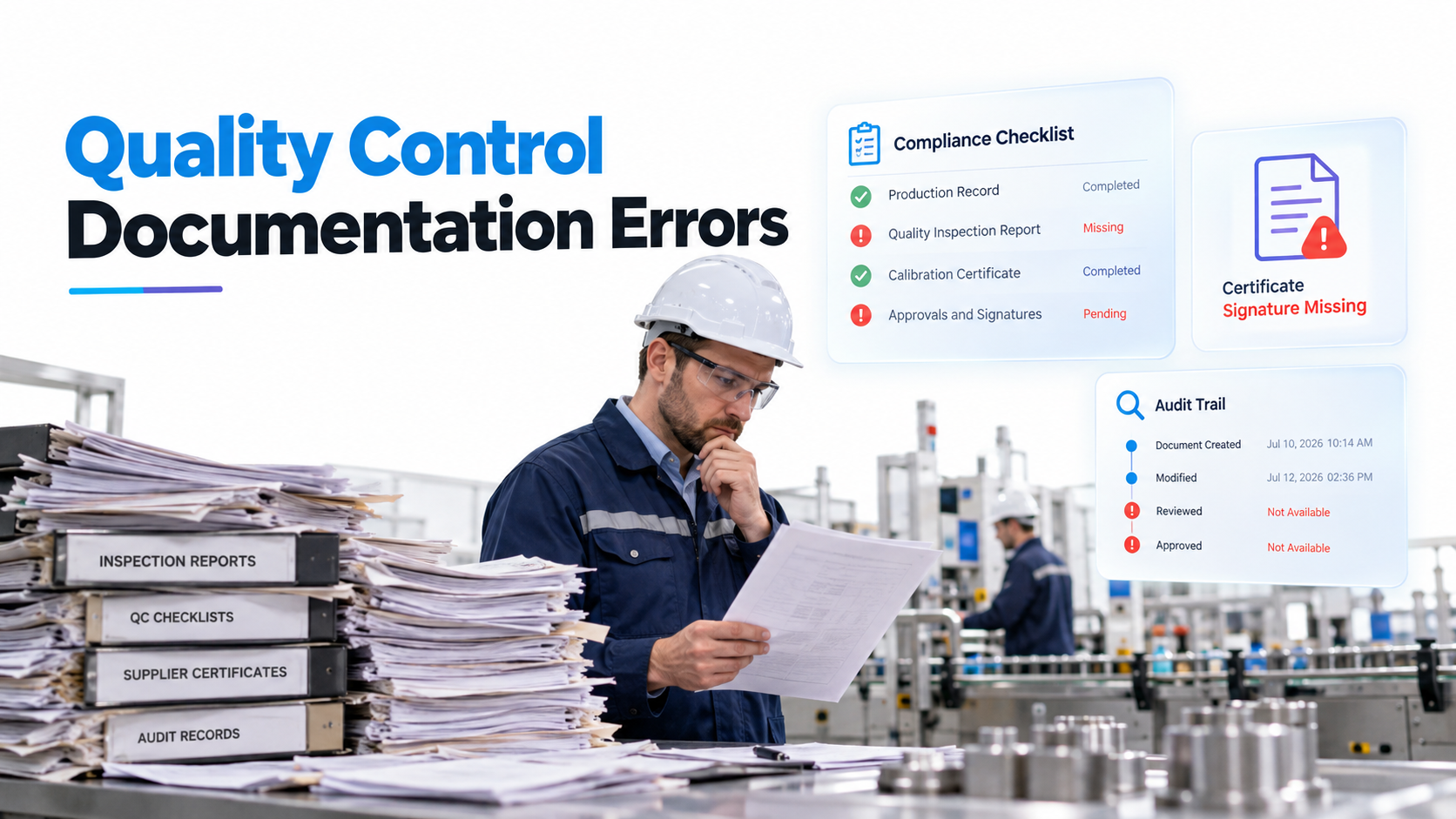
- Missing or Incomplete Sign-Offs: An operator completes a test but can’t find the supervisor to initial the result. The traveler sits on a desk. By the time it gets signed, the date and time are ambiguous. During an audit, there’s no proof of when the test actually happened.
- Version Control Nightmares: Multiple copies of QC forms circulate. Corrections are made with white-out or erasure instead of documented amendments. An auditor asks which version is official, and nobody can answer with confidence.
- Illegible or Ambiguous Entries: Handwriting is unclear. Units are wrong (ppm vs. percent). Date formats vary across shifts. A test result that looks like “2.5” might actually be “2.8.” No audit trail captures the original handwriting.
- Lost or Damaged Physical Records: Moisture damage in humid production areas. Records misfiled or moved between departments without tracking. A batch record disappears; you hope it’s archived, but you can’t prove it.
- No Audit Trail: You can’t see who changed what, when, or why. If a deviation occurs, tracing root cause takes weeks of manual investigation instead of hours of digital drilling down.
- Traceability Breakdown: Batch numbers aren’t consistently linked to test results. Serial numbers are missing from inspection records. Rework and retest documentation lives in separate files, creating orphaned records and impossible-to-reconstruct genealogies.
Get this wrong and the consequences are severe. Regulatory action becomes likely. Customer audits fail. Recalls trigger because you can’t rapidly prove which lots are affected. You’re wasting time on manual record searches instead of being proactive. Your credibility with auditors erodes fast.
The Solution: A Centralized Manufacturing DMS for QC Compliance
Manufacturing quality control documentation transforms when you move from legacy paper and spreadsheet systems to a purpose-built Document Management System. The shift isn’t about replacing human judgment, it’s about making every decision auditable, traceable, and defensible.
A centralized DMS built for manufacturing creates structural safeguards against documentation errors before they happen:
- Structured Digital Forms: Mandatory fields prevent incomplete entries. Dropdown selections eliminate ambiguity (ppm is always ppm, not a handwritten guess). Mobile and tablet-enabled forms let operators enter data at the point of test, not hours later from memory.
- Automatic Time-Stamping and User Authentication: Every entry is logged with operator ID, precise timestamp, and digital signature. The system captures who did what and when, making tampering evident and auditors confident.
- Version Control and Amendment Tracking: Changes are never overwritten. Every edit is recorded with a reason code and full audit history. An auditor can see the original entry, all amendments, and who made each change.
- Centralized Repository: No hunting through file cabinets or email attachments. One source of truth. Instant retrieval by batch, date, lot number, or test type. During a crisis or audit, you find the data in seconds, not days.
- Audit Trail Compliance: A system designed for manufacturing meets FDA 21 CFR Part 11, ALCOA+ principles (Attributable, Legible, Contemporaneous, Original, Accurate, plus Access Control, Audit Trail, and Abbreviations compliance), and ISO standards.
- Integration with ERP/MES: Quality data flows automatically to batch records, genealogy systems, and deviation workflows. Traceability becomes automatic, not manual.
Expert Perspective
A robust DMS doesn’t eliminate human decision-making in QC, it ensures that every decision is documented, traceable, and defensible. This shift from hoping you haven’t missed anything to knowing you have proof is what transforms compliance from a constant risk into a measurable, auditable strength.
When evaluating a manufacturing quality control documentation solution, look for systems built specifically for regulated manufacturing, not generic document storage platforms. The partner should have deep industry experience (FDA, ISO, IATF, AS9100), built-in compliance frameworks rather than bare-bones architecture, and user-friendly design that actually drives adoption on the factory floor. Security, scalability across multiple facilities, and robust backup and disaster recovery capabilities are table stakes, not differentiators.
Why Leading Manufacturers Choose a Purpose-Built QC DMS
The gap between generic file-sharing systems and purpose-built manufacturing quality control documentation platforms is enormous. Let’s compare three approaches side-by-side:
| Feature | Generic File Share / Spreadsheet | Legacy / Local System | Purpose-Built Manufacturing DMS |
|---|---|---|---|
| Audit Trail | None; impossible to track changes | Limited; manual logging required | Full; automatic, 21 CFR Part 11 compliant |
| Data Integrity | High risk of overwrites and version confusion | Medium; some controls in place | High; checksums, encryption, access controls |
| Traceability | Manual cross-referencing; data silos | Partial; batch links are weak | Complete; batch to test to result to approver |
| Mobile / Offline Capability | Limited or unreliable sync | Sometimes available; sync issues | Designed for floor use; offline plus sync |
| Regulatory Proof | Not auditable; weak for inspections | Moderate; requires manual compilation | Inspection-ready; automated compliance reports |
| Integration | Difficult; persistent data silos | Limited; vendor-dependent | ERP/MES-ready; automated data flow |
Purpose-built systems excel in three ways. First, they’re designed from regulatory requirements outward, not retrofitted afterward. Second, they prioritize factory-floor user experience: barcode integration, real-time lookup, minimal clicks, offline capability. They treat operators like operators, not office workers. Third, they enable investigative power that saves days of manual work. Rapid drill-down from deviation to batch to all related tests to operator notes and approval chains, compressed into hours instead of days.
Worth noting: a manufacturing quality control documentation system purpose-built for your industry eliminates the false choice between “strict compliance” and “actually usable.” Operators don’t resist systems they can use quickly and intuitively. Adoption accelerates, data quality improves, and compliance becomes an outcome of normal work, not something bolted on afterward.
Real-World Applications Across Manufacturing Sectors
Pharmaceuticals and Biotech
In pharmaceuticals, batch records and traveler cards are non-negotiable assets. Every test result must be audit-trail protected. Test certificates must link to certificates of analysis. Deviation documentation must capture root cause and corrective actions in real time. Manufacturing quality control documentation failures in this sector trigger FDA warning letters and potential product recalls. Sound familiar?
A purpose-built DMS prevents batch holds due to lost test data, accelerates product release timelines, and ensures that FDA inspections surface confidence in your system, not scrambling to locate records.
Medical Devices
ISO 13485 and FDA traceability requirements demand immutable QC records. Customer audits (OEM supply chains) expect digital proof of compliance, not scanned paper. Manufacturing quality control documentation in this space is directly tied to your ability to win and retain customers.
A centralized DMS enables rapid responses to customer quality questions and simplifies complaint investigations, turning documentation from a liability into a competitive strength in customer audits.
Automotive and Tier-1 Suppliers
IATF 16949 and customer audits (OEM second and third-party assessments) require Statistical Process Control charts, Advanced Product Quality Planning records, and run-at-rate documentation. Manufacturing quality control documentation in automotive supply is scrutinized at a granular level.
Digital QC records with trend analysis capabilities demonstrate statistical rigor to customers and give you evidence of continuous improvement that paper systems simply can’t provide.
Food and Beverage
FSMA (Food Safety Modernization Act) and HACCP require time-stamped, verified records of critical control points. Paper records in food manufacturing invite FDA scrutiny and create liability if recalls occur.
A manufacturing quality control documentation system ensures complete traceability from raw material receipt through finished goods distribution, which is essential for rapid, credible recalls if ever needed.
How to Get Started: A Phased Approach
Implementing manufacturing quality control documentation doesn’t require a big-bang transformation. A phased approach reduces risk and allows your team to learn as you scale:
- Assess Current State. Map existing QC documentation flows, forms, approval chains, and retention policies. Identify specific compliance gaps: missing audit trails, orphaned records, illegible entries, traceability breakdowns. Engage quality, operations, IT, and regulatory stakeholders to understand pain points. Outcome: Clear baseline and prioritized improvement opportunities.
- Define Requirements and Select Solution. Document regulatory requirements specific to your industry and customers (FDA, ISO, IATF, customer audits). Evaluate systems for industry fit, usability on the factory floor, and IT/security alignment. Define scope: which products, production lines, facilities, and document types go digital first. Outcome: Aligned team and a selected platform matched to real needs.
- Design and Configure. Create standardized digital QC forms (inspection checklists, test entry templates, deviation logs). Set up access controls, approval workflows, and data retention policies aligned with your regulations. Test integration with ERP/MES systems if needed. Outcome: System ready for pilot use on the factory floor.
- Pilot and Train. Roll out manufacturing quality control documentation to a single product line or shift. Gather feedback from operators and supervisors. Conduct hands-on training and address usability concerns in real time. Iterate on form design and workflows based on what you learn. Outcome: Refined process and confident users ready for scale.
- Full Deployment and Continuous Improvement. Expand manufacturing quality control documentation across all relevant lines and facilities. Establish governance: data stewardship, form change control, audit procedures, and metrics for quality improvement. Monitor adoption and refine based on feedback.
Throughout this journey, measure success not by system complexity, but by adoption (operators using it willingly because it makes their jobs easier) and by audit readiness: your ability to retrieve any QC record in seconds and prove its integrity to an inspector.

Frequently Asked Questions
What happens if we don’t fix manufacturing quality control documentation errors?
The risks compound over time. A single missing audit trail might go undetected until a customer or regulatory audit occurs. At that point, you’re scrambling to reconstruct history, potentially unable to prove compliance, facing customer holds, and risking regulatory action including warning letters or consent decrees. The cost of reactive remediation far exceeds the cost of preventing the errors upfront.
Is manufacturing quality control documentation software only for large manufacturers?
No. Mid-sized and smaller manufacturers face the same regulatory requirements as large enterprises. In fact, smaller teams often benefit more from automation because they’ve got fewer resources to spend on manual record hunting and compilation. The key is choosing a solution sized appropriately to your complexity and growth trajectory, not your current size.
How do we ensure operators actually use the system instead of reverting to paper?
Adoption succeeds when the system is faster and easier than the old way. Design digital forms with the operator in mind, not the auditor. Mobile capability, barcode scanning, and minimal typing are non-negotiable. Involve operators in design and training. Make it clear that the system makes their job easier, not harder. Leadership commitment to using the system for daily decisions (not just compliance) signals that this is the new standard, not optional.
Do we need to replace our ERP system to implement manufacturing quality control documentation software?
No. A purpose-built DMS can integrate with most ERP and MES platforms, pulling batch identifiers and pushing quality results back without requiring a full system replacement. Integration might require some middleware or API configuration, but that’s far less disruptive than replacing your core systems. Discuss integration architecture with your vendor during evaluation.
What should we look for in a vendor when evaluating manufacturing quality control documentation systems?
Look for vendors with proven experience in your industry (pharmaceuticals, medical devices, automotive, food) and with your relevant regulations (FDA 21 CFR Part 11, ISO 13485, IATF 16949, AS9100). Verify that the system is designed for manufacturing, not just document storage. Request references from similar companies and ask about their implementation approach, training support, and ongoing optimization. Prioritize vendors committed to your success, not just your initial purchase.
Ready to Transform Your Quality Documentation?
Stop losing time to manual record searches and regulatory risk. Discover how a centralized, auditable manufacturing quality control documentation system turns compliance into a competitive advantage. Let’s talk about your specific challenges and build a roadmap to audit-ready operations.