Best Document Management Software in India: A Complete Guide for Modern Businesses
Document management software in India is revolutionizing how modern businesses organize, secure, and retrieve critical information. From startups in Mumbai to enterprises across Pune and Delhi, Indian companies face a unique challenge: scaling document workflows while maintaining compliance with Indian regulations, data localization rules, and GST requirements. The right document management system eliminates chaos, accelerates approvals, and protects your business from regulatory risk.
Key Takeaway
A modern DMS eliminates manual document handling, ensures compliance with Indian regulations like GST and RBI guidelines, and enables seamless remote collaboration. That’s critical for India’s post-pandemic hybrid workforce and distributed teams.
In This Article
- Why Now? The Document Management Imperative in India
- Key Challenges Indian Businesses Face Without Proper Document Management
- How Document Management Software Solves These Challenges
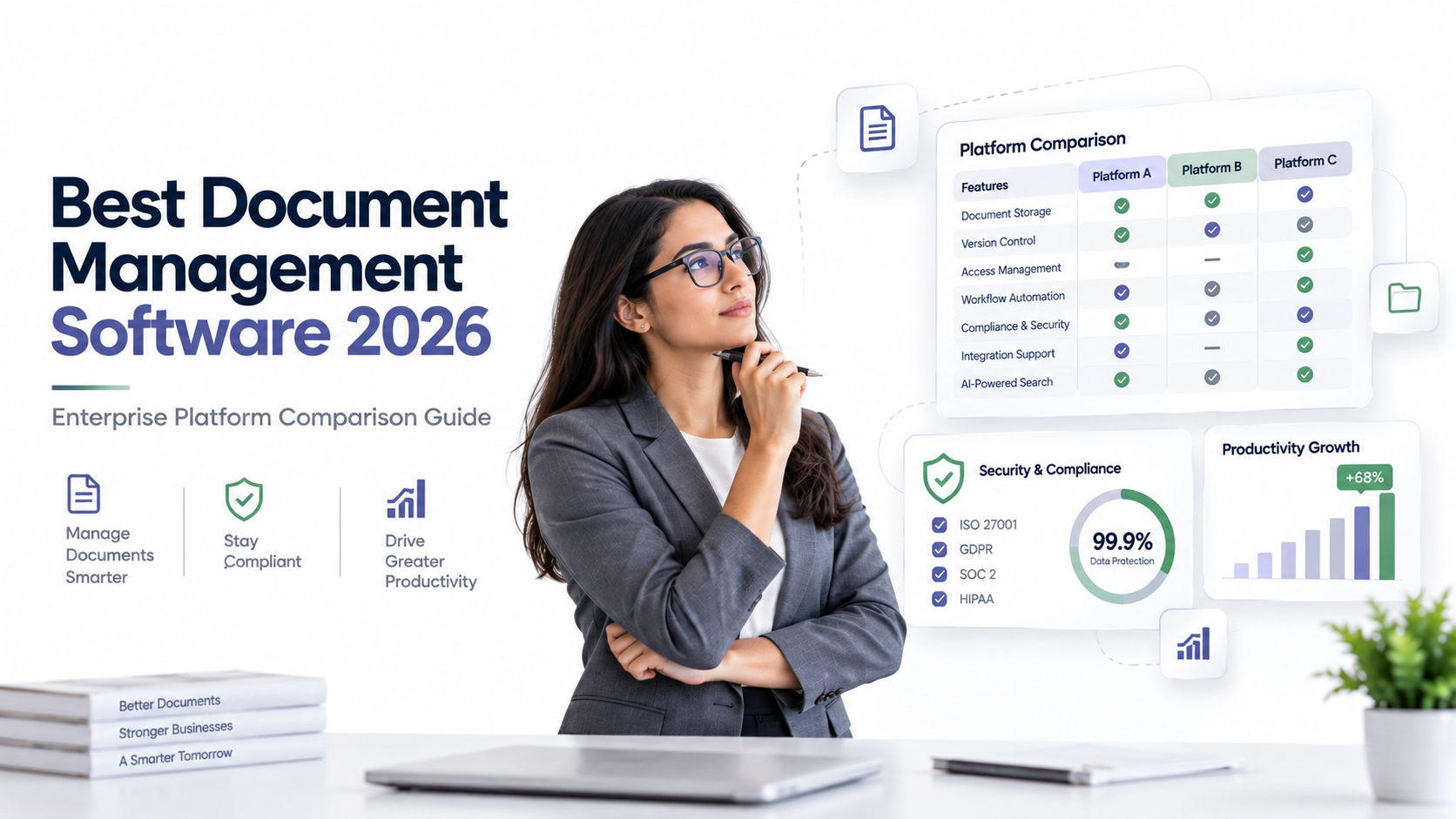
- What to Look for in a Document Management System for Indian Businesses
- Industry-Specific Applications in India
- How to Get Started with a Document Management Solution
- Frequently Asked Questions
Why Now? The Document Management Imperative in India
India’s digital economy is growing at 2x the rate of traditional sectors. Businesses face mounting pressure to go digital, not just for competitive advantage, but for regulatory survival. The GST regime demands meticulous invoicing records. The Indian Penal Code Section 65A now grants electronic documents the same legal standing as paper records. The RBI’s push toward paperless banking, combined with MEITY’s digital document guidelines, means compliance isn’t optional anymore.
Here’s what’s really changed: India’s workforce landscape has fundamentally shifted. Remote-first startups, multi-location enterprises, and gig economy workers demand access to documents from anywhere. Email chains and USB drives don’t cut it. Teams in Pune need to approve contracts drawn up in Chennai. HR in Mumbai must access employee records filed in Bangalore. Without a centralized document management system, this coordination falls apart fast.
“Over 60% of Indian SMEs still manage 40% or more of their documents manually, losing productivity and regulatory defensibility in the process.”
NASSCOM Digital Transformation Report, 2024
On top of that, India’s regulatory environment is tightening. Income tax audits scrutinize document retention. Banking regulators demand audit trails. Manufacturing firms exporting goods need compliance documentation for international standards. The cost of getting document management wrong, in fines, penalties, or lost business, now exceeds the cost of implementation. That’s the shift.

Key Challenges Indian Businesses Face Without Proper Document Management
When businesses lack a formal document management system, they face cascading problems that drain productivity and increase risk. Sound familiar?
- Regulatory and Compliance Risk: GST audits demand invoice trails you can’t produce. Income tax scrutiny reveals missing payroll records. Banking regulators ask for document audit trails you never created. Non-compliance penalties can reach thousands of rupees, and reputation damage lasts far longer.
- Operational Inefficiency: Time spent searching for documents compounds across your organization. A Finance Manager spends 45 minutes finding the original purchase order. An HR Manager can’t locate the employee’s original job offer. Approvals stall because someone has to chase down a file shared via email three months ago. This inefficiency scales with team size.
- Security and Data Loss: Physical documents get stolen or damaged. Digital files stored across personal computers and external drives disappear in hardware failures. Sensitive vendor data, customer contracts, and employee records sit unencrypted and unbacked up. A single laptop theft exposes confidential information.
- Scalability Challenges: As your team grows, document storage becomes unwieldy. Version control breaks down. An engineer pulls an SOP last updated six months ago, unknowingly using an outdated process. Access control disappears, everyone with a shared folder has the same permissions, including delete rights.
- Collaboration Friction: Teams across time zones can’t access documents simultaneously. Email attachments create version confusion. You end up with “Final_v3_updated_REAL.docx” scenarios where no one knows which is current. Remote workers feel disconnected from centralized information.
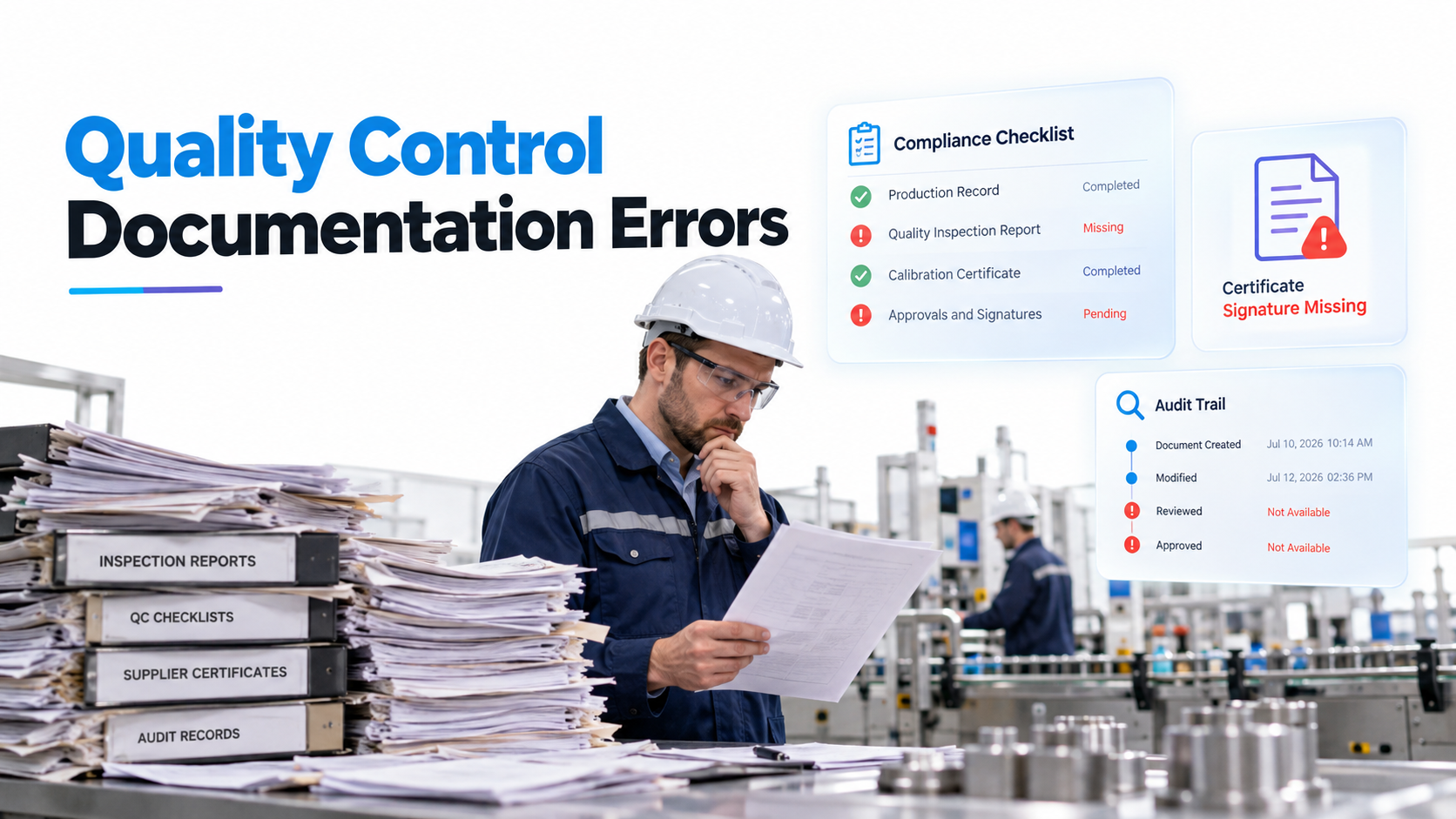
- Audit and Retention Headaches: You have no systematic retention policy. Confidential financial records sit next to non-sensitive PDFs. When a regulator asks for records from 2022, you can’t prove you kept them or when you deleted them. ISO 9001 and ISO 27001 audits fail because you can’t demonstrate proper document control.
These challenges don’t just cost money in lost productivity. They expose you to legal liability, regulatory penalties, and reputational damage that no business can afford.
How Document Management Software Solves These Challenges
Document management software in India addresses each of these pain points with targeted capabilities. The right platform transforms how your organization handles information.
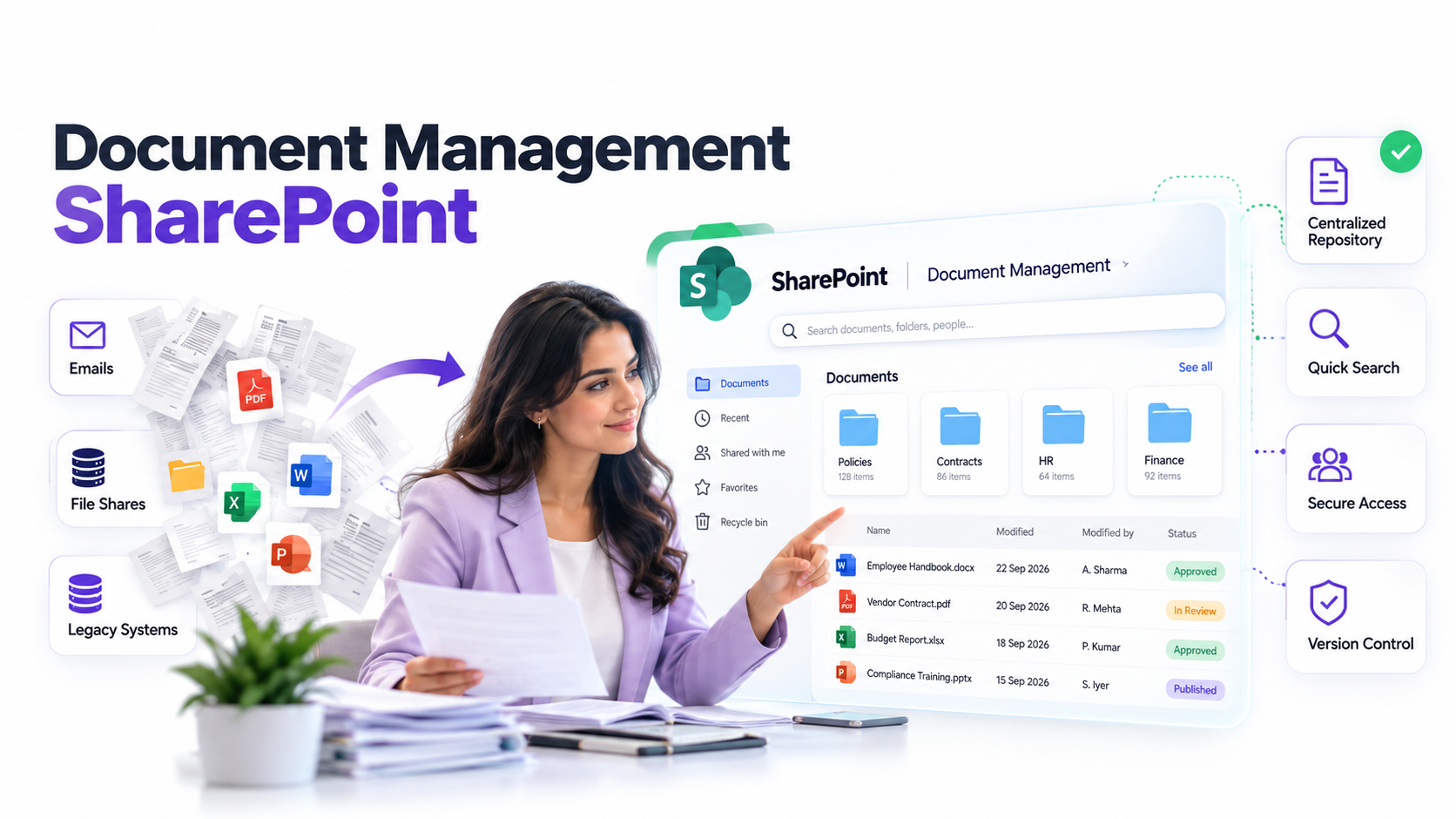
Centralized, Searchable Repository: All documents live in one place, indexed and organized by metadata. Instead of digging through folders, Finance finds the invoice by entering the vendor name or invoice number. HR retrieves an employee’s onboarding documents in seconds. The system’s OCR (Optical Character Recognition) technology even reads handwritten dates and vendor stamps, making old scanned documents fully searchable.
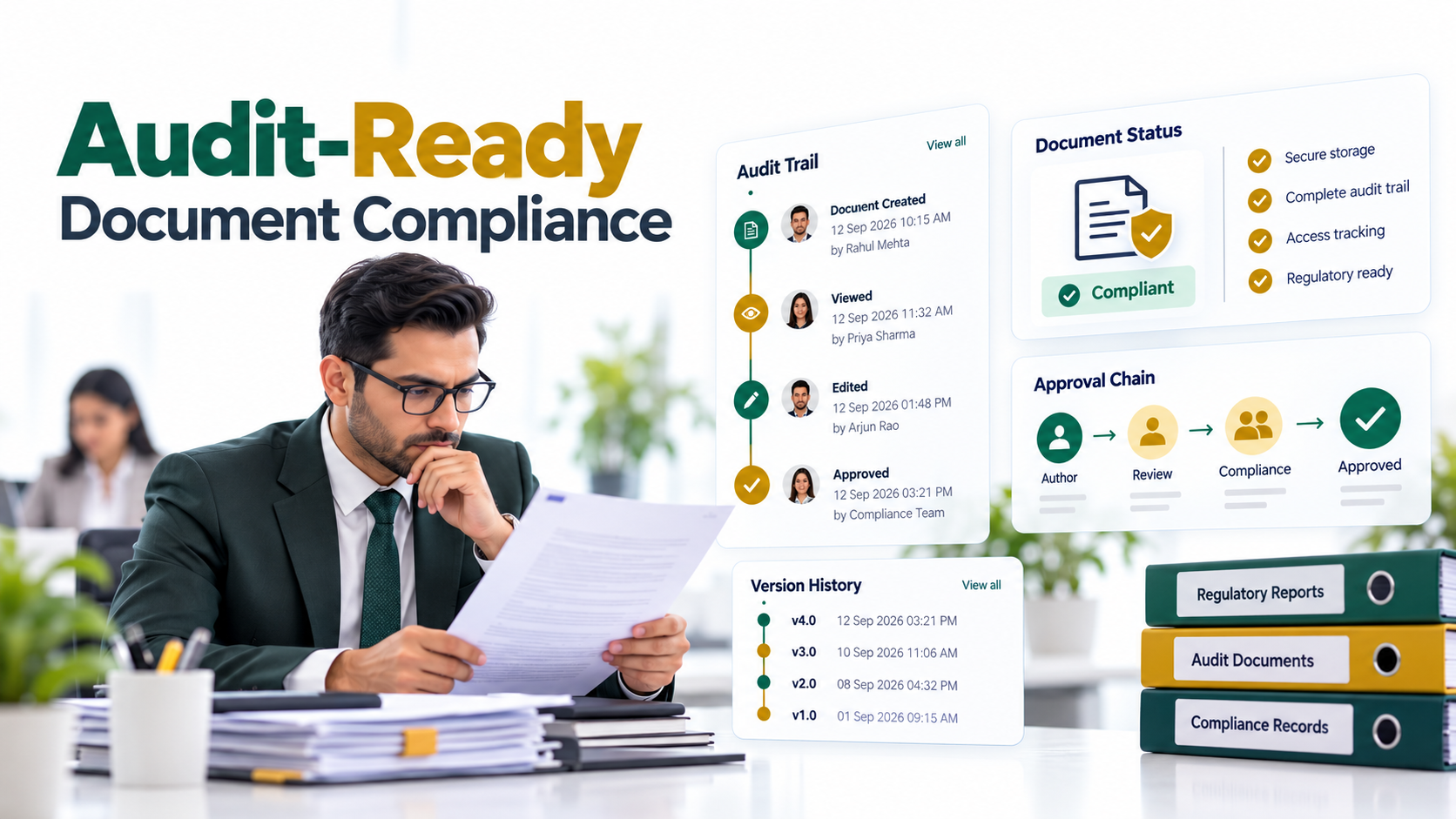
Compliance and Audit Ready: Document management software includes built-in retention policies aligned with Indian regulations. The RBI Master Circular requirements for banking? The system enforces retention windows automatically. GST compliance? Document audit logs show exactly who accessed which invoice when. eSignature integration supports e-Mudra and other Indian government-approved digital signature standards. Compliance isn’t a problem you solve once. It’s built into ongoing operations.
Secure Access Control: Role-based permissions ensure Finance can’t access HR records, and Operations can’t delete completed contracts. Encryption protects data at rest and in transit. Many solutions offer Indian cloud server options, meeting data localization requirements critical for banking and healthcare sectors. Multi-factor authentication prevents unauthorized access, even if a password gets compromised.
Workflow Automation: Define approval chains once, and the system handles routing. When Finance submits a purchase order, it automatically routes to the Procurement Manager, then to the CFO, with notifications at each step. There’s no “chasing someone for a signature.” The workflow is transparent, tracked, and auditable. Contract review cycles that took weeks now take days.
Version Control: Collaboration is no longer a chaos of conflicting files. The system maintains a complete edit history. You can revert to any previous version, see who made changes and when, and prevent simultaneous edits that create conflicting versions. This is especially critical in legal and manufacturing, where version control directly impacts compliance.
Expert Perspective
In our work with Indian businesses, we’ve observed that companies pairing a strong DMS with a clear document taxonomy and change management program achieve adoption rates above 80%. Those that treat the software as a “set and forget” tool struggle to justify the investment and frequently return to old habits.
Cloud Scalability: Start with one department, grow to 500 users without investing in on-premise servers. Cloud-based document management software scales automatically. Your infrastructure grows with your business, and you pay only for what you use. This model is especially attractive for India’s fast-scaling startups and seasonal enterprises.
Integration Ecosystem: Your DMS doesn’t exist in isolation. Modern platforms integrate with Tally (critical for Indian accounting), SAP, Microsoft 365, Google Workspace, and banking platforms. When Finance records an invoice in Tally, it automatically files the scanned document in your DMS. When HR creates an employee record in your HRIS, the system creates a folder and applies the correct retention policy. Integration eliminates manual re-entry and data silos.
What to Look for in a Document Management System for Indian Businesses
Not all document management systems are created equal. When evaluating solutions, prioritize features specific to Indian business needs.
Regulatory Compliance: The system must support data localization, servers physically located in India. It should come with pre-built compliance templates for GST, RBI document retention, SEBI norms, and Indian Penal Code Section 65A requirements. Verify that the vendor can demonstrate compliance with MEITY guidelines for government document submissions. eSignature support must include Indian government-approved standards like e-Mudra, not just generic digital signatures.
User Adoption and Ease of Use: Document management software is only effective if people actually use it. The interface must be intuitive enough that an HR Manager with limited technical skills can upload an offer letter without training. Mobile access is essential. Employees working from multiple sites need to access documents from smartphones. The system should support multi-language interfaces, reflecting India’s linguistic diversity. Hindi, Tamil, Telugu, Kannada support aren’t nice-to-have features. They’re adoption blockers if missing.
Security and Encryption: Verify SSL/TLS encryption for data in transit. Data at rest should be encrypted using AES-256 or stronger standards. Two-factor authentication protects against compromised credentials. Look for third-party security certifications: SOC 2 Type II compliance, ISO 27001 for information security management. For banking and healthcare clients, certifications become non-negotiable.
Workflow Customization: Every industry has unique approval chains. Finance needs multi-level approval for high-value purchases. HR needs attestation from multiple managers for sensitive employee documents. Look for drag-and-drop workflow builders that don’t require coding. Conditional logic, “if purchase order exceeds 5 lakhs, require CFO approval,” should be configurable without developer intervention.
Scalability and Performance: Test the system with your actual document volumes. Can it handle 10 million documents? 100 million? What’s the search response time? For organizations with large file repositories or many concurrent users, performance degrades noticeably with the wrong platform. Plus, the system must support integration via APIs. Avoid proprietary connectors that lock you in.
Support and Training: Choose a vendor with local presence in India. Support should be available in your timezone, not just US business hours. Training materials, documentation, and onboarding resources should be available in Hindi and regional languages. A vendor responsive to Indian customers will understand local compliance nuances that global platforms might miss.
Industry-Specific Applications in India
Financial Services and Banking
Banks and financial institutions face the strictest regulatory requirements. RBI Master Circulars mandate specific document retention periods: loan files for 7 years, KYC documents indefinitely, transaction records for compliance audits. Document management software automates this. When a loan is fully repaid, the system archives all related documents according to RBI requirements. KYC updates are tracked with version history, proving compliance to regulators. Loan approval workflows eliminate manual sign-offs and create an auditable approval trail that passes regulatory inspection every time.
Healthcare and Pharmaceuticals
Clinics and hospitals manage patient records that are both legally protected and operationally critical. Patient privacy is non-negotiable. Pharma companies managing clinical trials, quality control records, and regulatory submissions need version-controlled document systems. A DMS with strong encryption and access controls ensures that a patient’s medical history is accessible only to authorized doctors and staff. For pharma exports, compliance documentation for international standards (GMP certifications, quality assurance records) must be available for regulatory audits on demand.
Manufacturing and Supply Chain
Manufacturers rely on SOPs (Standard Operating Procedures), supplier quality agreements, purchase orders, and compliance certifications. The top 10 Document management software centralizes this ecosystem. When a quality issue arises, the system instantly retrieves the SOP version used at the time of production. Supplier contracts are stored with version history, preventing disputes over terms. For exports, compliance documentation (CE marks, ISO certifications, test reports) is organized and accessible for customs clearance. A distributed manufacturing operation spanning multiple plants uses a DMS to ensure every facility follows the same, current SOPs.
Human Resources and Recruitment
HR departments manage employment contracts, offer letters, payroll records, leave applications, and compliance filings (EPF, ESI, labor law documentation). Document management software streamlines onboarding. New hires’ documents are automatically filed in a standardized folder structure. Leave approvals workflow through the system, creating an audit trail if disputes arise. Compliance filings for labor inspections are organized by requirement, making audits faster and less risky. Employee separation documents are archived according to labor law retention requirements, protecting both the business and the departing employee.
Real Estate and Legal Services
Real estate transactions involve hundreds of documents: property deeds, title searches, agreements, municipal clearances, and client correspondence. Version-controlled document management is essential. A contract negotiated over weeks may have 15 iterations, and confusion over which version is final causes legal disputes. A DMS maintains complete version history, preventing “which version did we sign?” arguments. Legal firms use document management software to organize client files, track document deadlines, and maintain audit trails that protect against malpractice claims.
Government and Public Sector
Government agencies managing RTI (Right to Information) requests, licenses, permits, and citizen applications need transparent, auditable document handling. Document management software supports India’s push toward e-governance. Citizens applying for business licenses can track document status. Agencies process applications faster with automated routing. Compliance with digital India mandates becomes feasible with a proper DMS backing operations.
How to Get Started with a Document Management Solution
Implementing document management software in India requires a structured approach. Rushing the process risks poor adoption and wasted investment.
- Assess Your Current State: Action: Audit existing documents, volume, format, location, pain points, current storage methods. Interview stakeholders across departments. Outcome: Understand scope, complexity, and which departments have the highest pain and greatest readiness for change.
- Define Business Requirements and Workflows: Action: Map critical document flows. Which documents need approval? Who approves? What are the bottlenecks? Document retention and compliance requirements per function. Outcome: A clear specification for vendor evaluation. Aligned expectations across departments reduce post-implementation disappointments.
- Evaluate Vendors and Request Demos: Action: Shortlist 3-5 solutions. Request live demos focused on your workflows, not generic features. Check references from similar Indian businesses. Verify compliance certifications and data residency options. Outcome: Identify the best-fit solution. Understand implementation approach, support model, and training commitment.
- Plan for Change Management and Adoption: Action: Designate power users per department. Plan training sessions in local languages. Define adoption KPIs (percentage of documents digitized, average retrieval time, approval cycle time). Outcome: Higher user adoption, faster ROI realization, reduced resistance to change across the organization.
- Implement in Phases and Iterate: Action: Pilot with 1-2 departments first. Gather feedback. Refine processes. Roll out company-wide in subsequent phases. Outcome: Smoother full deployment. Lessons learned reduce organization-wide friction. Teams see value before full commitment.

Frequently Asked Questions
What’s the difference between document management software and cloud storage like Google Drive or OneDrive?
Cloud storage is file storage. It’s great for personal or team file sharing. Document management software is purpose-built for organizations. It adds compliance automation, workflow routing, version control, retention policies, audit logging, and role-based access control. You can’t configure retention policies in Google Drive. You can’t create approval workflows or audit trails. For personal or small team use, cloud storage is sufficient. For regulated industries or large organizations, document management software is necessary.
Is document management software required for GST compliance in India?
Not explicitly required, but heavily recommended. The GST Act doesn’t mandate a specific software. However, GST audits require you to produce invoices, supporting documents, and proof of record-keeping. A DMS makes this trivial. You search and retrieve instantly. Without one, you’re manually digging through filing cabinets or email folders. Additionally, GST compliance benefits from workflow automation (invoice approval before filing) and audit trails that DMS systems provide natively. The GST officer assessing compliance is more confident when you can produce organized, timestamped records.
Can document management software integrate with Tally, SAP, or other Indian business software?
Most modern platforms support integration via APIs. Tally integration is becoming standard as vendors recognize India’s reliance on Tally for accounting. SAP integration is common for larger enterprises. Verify integration support during vendor evaluation. Ask for a technical integration roadmap. Some vendors offer pre-built connectors; others require custom development. Integration capability is a critical evaluation criterion, especially if you’re already invested in ERP systems.
What happens if my document management vendor goes out of business or stops supporting the product?
This is a legitimate concern. Verify the vendor’s financial stability and years in business. Confirm data export capabilities. You should be able to download all your documents in standard formats (PDF, DOCX, etc.) without vendor lock-in. Request a contractual data escrow clause: if the vendor ceases operations, your data is released to you immediately. Avoid proprietary formats that are unreadable without the vendor’s software. These precautions protect you from being stranded with inaccessible documents.
How long does implementation take, and what factors influence the timeline?
Implementation timelines vary significantly based on organization size, document volume, complexity of workflows, and readiness for change. A 50-person startup might move faster than a 500-person enterprise with legacy systems. The scope of integration with existing software, the depth of customization required, and how thoroughly change management is executed all influence pace. Rather than assuming a fixed timeline, work with your vendor to assess your specific situation and create a realistic roadmap during the discovery phase.
What’s the typical cost structure for document management software in India?
Pricing models vary widely: per-user monthly subscriptions, tiered storage-based pricing, or hybrid models combining both. Some vendors charge setup fees or migration fees for moving existing documents. Rather than relying on generic pricing information, request a custom quote based on your user count, anticipated document storage, and required features. Cost considerations should factor in implementation support, training, and ongoing vendor support. The cheapest software isn’t the best value if implementation fails or adoption is low. A conversation with the vendor’s sales team, providing your specific requirements, will yield an accurate estimate.
Ready to Transform Your Document Management?
AscenWork helps Indian businesses implement document management systems that align with local compliance requirements and drive team adoption. We understand the unique challenges of India’s business landscape, from GST compliance to multi-location deployments to employee training in regional languages. Reach out to discover how a proper DMS can eliminate document chaos and reduce regulatory risk.
Worth noting, organizing business documents across multiple departments becomes manageable when you have a centralized system enforcing consistent taxonomy and access controls.
For teams relying on Microsoft infrastructure, SharePoint development services often integrate with your document management strategy, especially when you need collaboration tools beyond pure document storage.
When document management is paired with workflow automation, approval bottlenecks disappear. Learn more about automating budget approvals and other document-driven workflows that benefit from this combination.