Invoice Approval Workflow Software: How to Streamline AP & Boost Compliance
Invoice approval workflow software transforms how finance teams handle accounts payable processes. Instead of manually chasing approvers via email, modern invoice approval workflow platforms automate routing, enforce approval hierarchies, and create audit-compliant documentation. For mid-market to enterprise organizations, this shift reduces bottlenecks, accelerates payment cycles, and strengthens compliance posture.
Key Takeaway
Modern invoice approval workflows reduce approval cycle time, prevent duplicate submissions, and integrate directly into Microsoft 365 SharePoint, eliminating manual email chains and creating compliance-ready audit trails.
In This Article
- Why Invoice Approval Workflow Matters Now
- The Core Challenge: Manual Invoice Approval Workflows
- The Solution: Invoice Approval Workflow Automation
- Why Leading Businesses Choose Microsoft 365 SharePoint for Invoice Approval Workflow
- Real-World Applications Across Industries
- How to Get Started
- Frequently Asked Questions

Why Invoice Approval Workflow Matters Now
The shift to hybrid and remote work has made traditional, in-person invoice approvals pretty much impossible. Finance teams still relying on email-based approval chains face mounting operational risk. Invoices get lost in message threads. Approvers away from their desks create bottlenecks. Vendors wait weeks for payment confirmations. Sound familiar?
On top of that, regulatory pressure around financial controls continues to intensify. SOX compliance, GDPR data governance, and local tax audit requirements all demand documented approval trails. Here’s the thing most organizations miss: email doesn’t provide the audit-ready evidence that regulators expect.
And there’s more. Cash flow visibility suffers when invoices sit in approval limbo. Late invoice processing means missed early-payment discounts, strained vendor relationships, and forecasting gaps that hurt treasury operations.
“Finance teams relying on manual, email-based approval processes spend an estimated 10, 15 hours per week chasing down missing approvals, re-routing documents, and correcting duplicate submissions.”
Insights from AP process audits across mid-market enterprises
The business case is straightforward: automation reduces administrative overhead, improves visibility, and closes compliance gaps. Organizations that modernize their AP processes gain a real competitive advantage in vendor relationships and cash management.
The Core Challenge: Manual Invoice Approval Workflows
Most finance teams inherit approval processes that grew organically over years, piece by piece. Email, spreadsheets, and informal handoffs create inefficiency at scale. Here’s what we typically see:
- Bottlenecks when approvers are unavailable: Invoices stall if a key approver is in a meeting, on vacation, or out sick. No one else has authority to move the document forward, and there’s no visibility into where it’s stuck.
- Compliance and audit risk: Email approval chains don’t create tamper-proof audit trails. Auditors struggle to verify segregation of duties, approval authority, or chronological sign-off sequences. Regulatory inspections expose gaps.
- Duplicate and fraud risk: Without centralized intake, the same invoice can be submitted multiple times by different vendors or departments. Fraudulent invoices slip through because there’s no exception-detection logic.
- Vendor payment delays: Slow approval cycles mean invoices sit in queues, leading to late vendor payments, lost early-pay discounts, and damage to supplier relationships.
- Scattered approval status: Finance leaders have no real-time visibility into AP health. Invoice status is buried in email threads. Dashboard reporting is impossible, so forecasting cash needs becomes guesswork.
- Integration headaches: Invoices are entered into email, transcribed into spreadsheets, then re-entered into accounting systems. Each handoff introduces errors, rework, and data quality issues.
The cumulative cost? It’s significant. Wasted admin time, compliance audit findings, vendor friction, and missed cash management opportunities add up quickly.

The Solution: Invoice Approval Workflow Automation
Invoice approval workflow software centralizes the entire AP approval process. Instead of manual routing, the system applies pre-configured business rules to move invoices automatically from intake through final payment authorization.
Here’s what modern invoice approval workflow platforms actually do:
- Automatic intelligent routing: Invoices are routed based on predefined rules: amount thresholds, department, vendor category, cost center, or custom fields. Low-value invoices auto-approve. High-value or unusual invoices escalate to senior approvers automatically.
- Conditional approval chains: Different approval paths for different scenarios. A $500 invoice in Marketing needs one sign-off. A $50,000 capital expenditure needs CFO review plus engineering sign-off. Rules adapt to your organization’s authority structure.
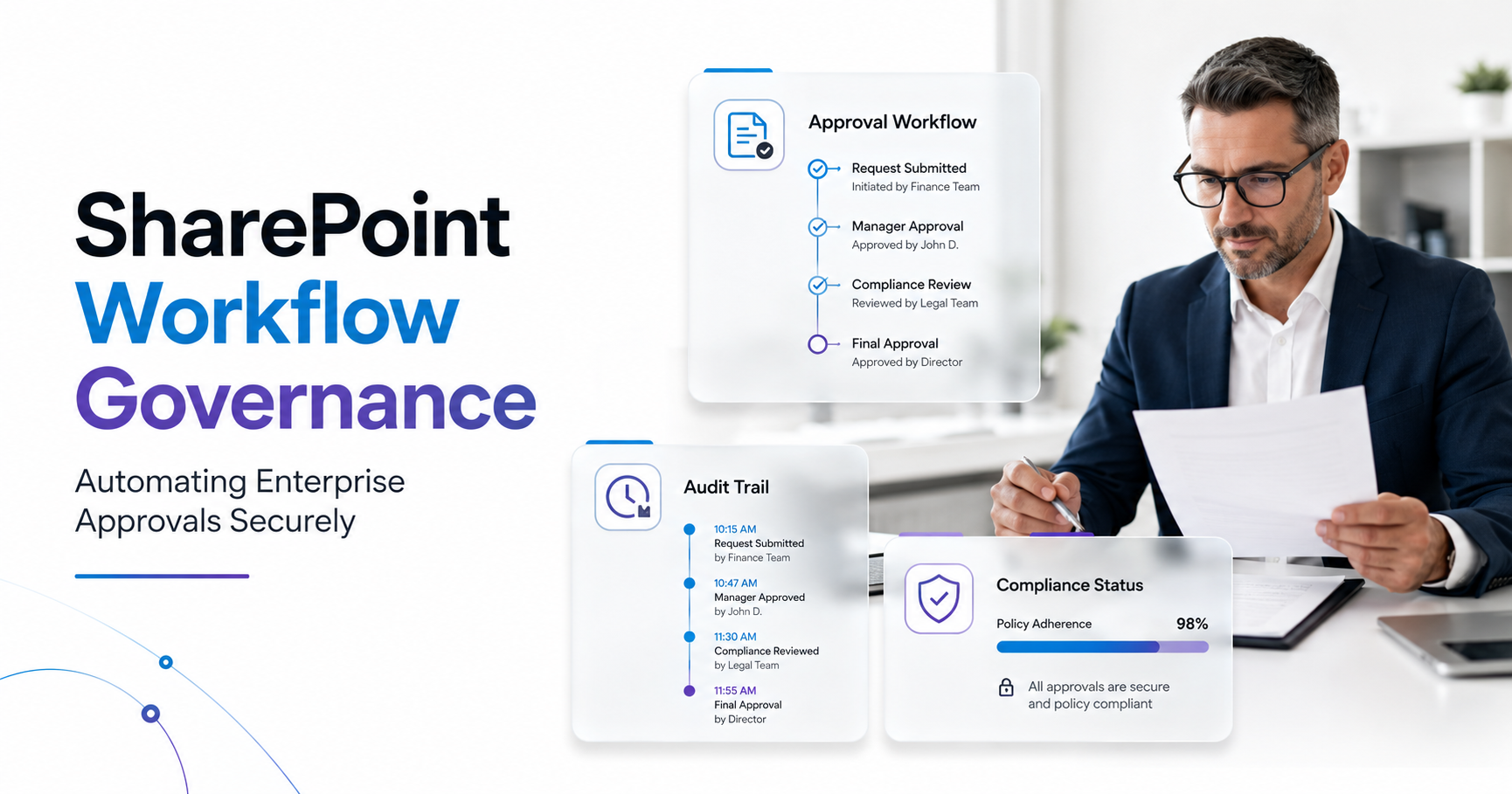
- Digital signatures and timestamps: Every approval is digitally signed and timestamped. This creates audit-ready documentation that satisfies SOX, GAAP, and regulatory review requirements.
- Cloud-based and mobile-ready: Approvers can review and sign off from anywhere, on any device. Hybrid teams stay productive without physical presence.
- API integration with ERP systems: The workflow connects directly to your accounting platform: SAP, Oracle, NetSuite, QuickBooks. Approved invoices flow automatically into the GL. No duplicate data entry.
- Real-time visibility dashboard: Finance leaders see bottlenecks in real time. Which invoices are pending? Who’s delaying approval? What’s the current AP aging? All visible in a single dashboard.
Expert Perspective
We’ve seen finance teams implement SharePoint-based invoice workflows with Power Automate and dramatically reduce approval cycle time. Here’s the catch: success depends on clear governance. Define approval roles, amount thresholds, and exception handling upfront. Without this clarity, even the best platform becomes chaotic. Organizations that invest in process mapping and change management consistently see the strongest results.
What to look for in a platform or implementation partner:
- Experience with mid-to-large enterprise AP processes. SMB workflows are fundamentally different from complex multi-level hierarchies and international vendor scenarios.
- Deep Microsoft 365 integration knowledge, especially SharePoint and Power Automate. If you’re already investing in Microsoft 365, leverage that ecosystem rather than adding another vendor platform.
- Compliance expertise. The partner should understand SOX, GDPR, audit documentation, and segregation of duties principles. This isn’t just about automation, it’s about control.
- Change management and training support. Technology alone doesn’t succeed. Teams need training, process documentation, and post-launch support.
Why Leading Businesses Choose Microsoft 365 SharePoint for Invoice Approval Workflow
When evaluating invoice approval workflow solutions, organizations typically consider three options: generic DIY SharePoint, third-party AP SaaS platforms, or Microsoft 365 with professional services. Each has real trade-offs. Here’s how they stack up:
| Dimension | Microsoft 365 + Professional Services | Third-Party AP SaaS | Generic DIY SharePoint |
|---|---|---|---|
| Integration with existing M365 tech stack | Native, single tenant, no licensing duplication | Connector-dependent, additional fees, vendor lock-in risk | Limited, requires IT workarounds |
| Approval logic & routing complexity | Advanced, fully customizable with Power Automate | Advanced, but change cycle controlled by vendor | Basic list workflows, limited conditional logic |
| Audit trail & compliance | Robust, within Microsoft’s SOX/GDPR compliance framework | Robust, but data residency outside your tenant | Basic audit log, limited controls |
| Scalability & change management | Direct control, modify rules at your pace | Vendor-dependent release cycle and product road map | High IT lift for changes |
| Cost structure | Upfront implementation + minimal ongoing licensing | Recurring per-user or per-transaction fees, compounding over time | Hidden admin time, opportunity cost |
Three factors really differentiate Microsoft 365-based invoice approval workflows:
First, ecosystem alignment. If your organization already uses Teams, OneDrive, Exchange, and SharePoint, a SharePoint-based invoice workflow integrates seamlessly. No additional vendor to manage. No separate login portal. No duplicate data exports between systems.
Second, compliance and data residency. Microsoft handles the heavy lifting on SOX, GDPR, HIPAA, and local regulatory compliance. Approval data stays in your tenant, under your control. No third-party SaaS vendor has access to sensitive financial records. For enterprises with strict data governance policies, this is non-negotiable.
Third, scalability without licensing surprises. SharePoint workflows cost the same to support 100 users or 1,000 users. Third-party platforms often charge per-user or per-transaction, which compounds quickly as your organization grows. With Microsoft 365, you expand your workflows without dramatic cost increases.
The trade-off is clear: you get more flexibility than SaaS, but you own the implementation responsibility. Success requires internal capability or a trusted implementation partner.
Real-World Applications Across Industries
Finance and Accounting (Corporate)
Large finance organizations use invoice approval workflow software to enforce multi-level sign-offs by cost center and amount. A procurement manager approves vendor invoices under $10,000. A department head approves $10,000 to $50,000. The CFO signs off on anything over $50,000 or unusual vendors. Invoices automatically route to the right approver based on amount and cost center. Real-time dashboards show CFO-level visibility into accounts payable aging, approval bottlenecks, and cash position.
Healthcare (Hospitals and Clinics)
Healthcare finance is heavily regulated. Invoice approval workflows enforce segregation of duties between procurement and accounts payable. The system prevents a single person from requesting, approving, and paying an invoice. Digital audit trails document every approval, supporting regulatory inspections and compliance audits. When vendor master data changes, the workflow triggers automatic CFO-level sign-off, reducing fraud risk from unauthorized vendors.
Retail and E-Commerce
High-volume, rapid vendor onboarding creates unique approval challenges. Retail invoice workflows route invoices by product category and vendor tier. Unusual vendors or unusually large orders flag for secondary review. Fraud detection rules catch duplicate invoices submitted under different invoice numbers. Real-time dashboard tracking helps finance leaders spot payment anomalies quickly.
Manufacturing and Logistics
Manufacturing workflows accommodate capital expenditure approvals that require engineering sign-off alongside finance approval. Multi-currency invoices and transfer pricing complexity require specialized routing logic. Supplier compliance verification is built into approval gates, invoices from non-compliant suppliers escalate automatically. The system enforces approval hierarchies that reflect both purchasing and engineering authority.
How to Get Started
Implementing an invoice approval workflow doesn’t happen overnight. It’s a structured process with clear milestones. Here’s the roadmap:
- Map your current process. Document your existing approval hierarchy, approval rules (by amount, vendor, department), exception cases, and compliance requirements. Outcome: You’ll have a baseline understanding of what needs to change and why.
- Define approval logic and rules. Establish conditional routing paths, approval limits for each role, escalation procedures, and exception handling. Outcome: A configuration blueprint that translates your business rules into workflow logic.
- Build SharePoint infrastructure. Create SharePoint lists for invoice intake, configure Power Automate workflows, set up integration connectors to your ERP or accounting system. Outcome: A functioning technical backbone ready for testing.
- Test with a pilot team. Run your approval workflow with one department or vendor cohort. Gather feedback on usability, routing accuracy, and compliance. Refine rules based on what you learn. Outcome: A validated design that’s ready for broader rollout.
- Train and roll out enterprise-wide. Provide training to all approvers and finance team members. Monitor adoption metrics. Refine rules based on live operational data. Outcome: Smooth adoption and sustained process improvements over time.
Throughout this process, clear communication with stakeholders is critical. Approvers need to understand the new process. Finance teams need training on dashboard tools. And executive sponsors need to see early wins to maintain momentum.
Frequently Asked Questions
How is a SharePoint invoice approval workflow different from traditional email approval chains?
SharePoint workflows create a centralized, auditable approval process with automatic routing based on business rules. Email chains scatter approvals across inboxes, create compliance risk, and offer no visibility into document status. SharePoint provides real-time tracking, prevents duplicate submissions, creates timestamped audit trails, and enables finance leaders to see bottlenecks instantly.
Can Microsoft 365 SharePoint handle complex multi-level approvals?
Absolutely. Power Automate supports conditional logic, parallel approvals, and dynamic escalation. You can route invoices based on amount, cost center, vendor type, GL account, or any custom field. Complexity grows with requirements, which is why many organizations work with implementation partners who specialize in finance workflow automation.
What about integrating with our ERP system like SAP, Oracle, or NetSuite?
SharePoint workflows connect to major ERP platforms via APIs or pre-built connectors. Once an invoice is approved in SharePoint, the system automatically pushes data to your ERP, eliminating manual re-entry. The integration architecture depends on your specific ERP version and data structure, so when considering SharePoint consulting for workflow automation, discuss integration requirements upfront with your partner.
How do we ensure our invoice approval workflow meets compliance requirements like SOX and GDPR?
Modern invoice approval workflows built on Microsoft 365 inherit Microsoft’s compliance frameworks. Timestamped digital approvals create audit-ready documentation. Access logs track who viewed or modified documents. Data stays in your Microsoft tenant, supporting data residency requirements. That said, your organization should audit the specific controls your workflow enforces and document them for internal compliance teams and external auditors.
What happens if an approver is unavailable?
Modern invoice approval workflows support delegation and escalation rules. If an approver is out of office, invoices can automatically escalate to their manager or a backup approver. Alternatively, approvers can pre-assign delegation authority to a colleague for specific date ranges. This prevents invoices from sitting idle while waiting for a single person to return.
Beyond invoice approvals, organizations that have invested in SharePoint contract document management solutions often find that the same governance and approval frameworks extend across AP, procurement, and contract lifecycle management, creating a unified control environment across finance operations.
Ready to Modernize Your Invoice Approval Process?
Organizations that automate invoice approvals see faster payment cycles, stronger compliance posture, and better vendor relationships. Let AscenWork help you design and deploy an invoice approval workflow that fits your organization’s complexity and compliance needs. We’ll work with you to map processes, configure workflows, integrate systems, and train your team for sustained success.