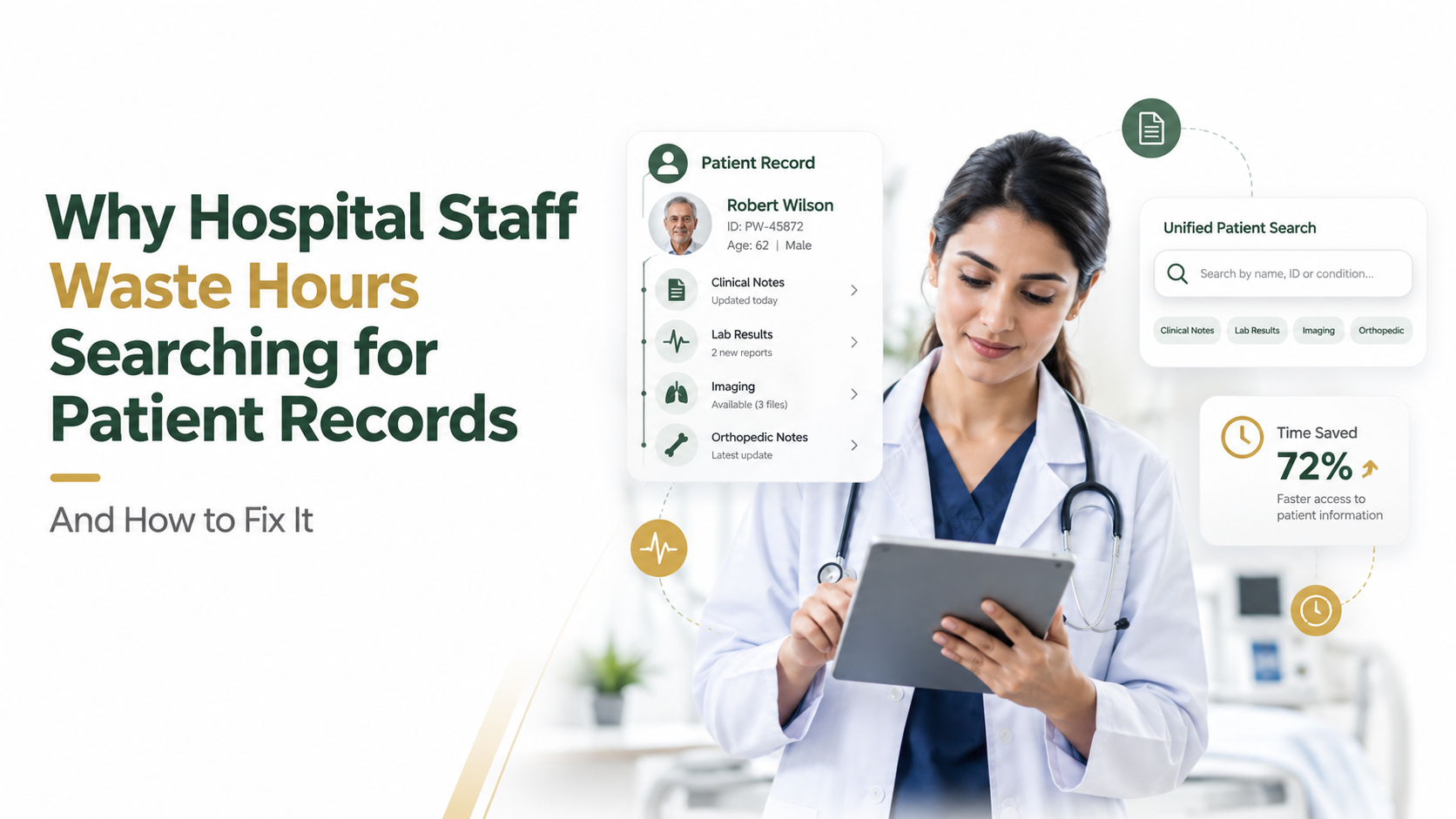
Why Hospital Staff Waste Hours Searching for Patient Records (and How to Fix It)
A patient arrives in your emergency department at 3 p.m. The attending physician needs orthopedic records from last month’s visit, lab results from cardiology, and imaging from radiology. Instead of instant access, nursing staff spend 10 to 15 minutes hunting across three separate systems. Meanwhile, the patient waits. Care gets delayed. Clinical decisions suffer. This scenario plays out thousands of times daily across hospitals nationwide, and it’s exactly why unified medical institutions are implementing a healthcare document management system today.
Key TakeawayModern healthcare document management systems eliminate silos by centralizing patient records across departments and enabling real-time clinical access. This reduces care delays, improves patient safety, and ensures regulatory compliance.
In This Article
- Why This Problem Is Escalating in Healthcare Today
- The Core Challenge Healthcare Administrators Face
- The Solution: Why a Healthcare Document Management System Matters
- Why Leading Healthcare Systems Choose Modern DMS Platforms
- Healthcare Document Management Across Different Departments
- How to Get Started With a Healthcare DMS
- Frequently Asked Questions

Why This Problem Is Escalating in Healthcare Today
Healthcare networks have grown more complex. Hospitals now operate multiple locations, specialized departments, and legacy systems that were never designed to talk to each other. According to the Healthcare Information and Management Systems Society (HIMSS), 73% of hospital administrators cite “information accessibility across departments” as a top operational challenge. It’s not new, but it’s become critical.
Most hospitals still rely on a fragmented tech stack. Clinical data lives in the Electronic Health Record, scanned documents sit in a separate Document Management System, paper files occupy physical storage, and specialty departments maintain their own archives. Radiology’s got PACS. Labs use their own LIS. Each system is optimized for its own workflow, not for clinicians who need to see everything at once. Sound familiar?
“Healthcare workers spend an estimated 25-30% of their clinical time searching for patient information across multiple systems rather than providing direct patient care.”
Journal of Medical Systems, 2023
The result is inefficiency at scale. Clinicians get frustrated. Patient care gets delayed. Compliance audits reveal gaps in access logs and document control. A modern healthcare document management system fixes this fragmentation directly.
The Core Challenge Healthcare Administrators Face
Patient record retrieval delays affect every department in a hospital. Here’s what administrators encounter daily:
- Clinicians delay patient care while waiting for records. A surgeon can’t start pre-op review. An ED physician can’t access prior imaging. Minutes turn into hours of lost productivity and compromised clinical judgment.
- Nursing staff manually search multiple systems. Instead of spending that time on direct patient care, nurses navigate separate logins, different interfaces, and outdated search functions. Burnout follows fast.
- Duplicate or conflicting information appears across departments. Radiology reports a finding. Pathology reports something different. No single source of truth exists, creating clinical risk and confusion.
- Paper records and scanned images are difficult to search at scale. OCR quality varies. Metadata’s incomplete. Finding a specific lab result from three years ago becomes a treasure hunt.
- Interdepartmental communication breaks down. Without centralized access, departments can’t verify what others know. This leads to redundant testing, missed diagnoses, and unnecessary patient procedures.
- Compliance audits reveal gaps in access control and audit trails. Regulators require proof that the right people accessed the right records at the right time. Legacy systems often can’t provide it.
When records aren’t accessible in seconds, hospitals face delayed diagnoses, compromised care quality, unnecessary duplicate tests, and regulatory scrutiny. The financial and clinical costs are substantial. Yet many organizations treat record access as a “tech problem” rather than a clinical and operational imperative. Here’s the thing most guides won’t tell you: this isn’t a problem you can solve with faster servers or better training alone.

The Solution: Why a Healthcare Document Management System Matters
A healthcare document management system isn’t just file storage. It’s an operational lever that connects every department to a unified patient record. Here’s how it fixes each pain point:
Unified search across all departments. Instead of logging into three separate systems, clinicians search once and get results from everywhere: EHR data, scanned documents, imaging reports, lab results, and archived files appear in a single, ranked list. That’s a game changer.
Role-based access controls ensure HIPAA compliance. The system enforces permissions automatically. An ED nurse sees emergency records. A cardiologist sees cardiac files. A billing clerk sees only what they need. Every access gets logged for audit purposes.
Automatic indexing and metadata make records instantly discoverable. Instead of manually tagging files, modern DMS platforms use machine learning to extract patient identifiers, dates, document types, and clinical concepts. Search returns results in milliseconds, not minutes.
Integration with existing EHRs and departmental systems. A true healthcare document management system doesn’t replace your EHR. It connects to it via API and industry standards like HL7 and FHIR. Data flows bidirectionally, keeping everything synchronized.
Audit trails for every access. Regulators require documented proof. A modern DMS logs who accessed what, when, why, and from where. This isn’t an afterthought, it’s built into the core system.
Mobile and remote access for modern workflows. Clinicians work in exam rooms, on rounds, and from home. A healthcare document management system delivers full access from tablets, phones, and laptops with the same security posture as the clinic.
Expert PerspectiveIn our work with healthcare clients, we’ve seen that a comprehensive document management system isn’t just storage. It’s an operational lever. It improves clinician satisfaction, reduces redundant testing, eliminates time spent searching, and creates a documented audit trail that supports compliance audits. Organizations that unify their records see faster clinical decisions and measurably better staff experience.
When evaluating a healthcare document management system, prioritize vendors who emphasize interoperability, HIPAA-native architecture, clinical workflow design, and robust support. Avoid vendors promising unrealistic speed gains or cost reductions. Look instead for partners who understand healthcare operations deeply and have worked with institutions similar to yours.
Why Leading Healthcare Systems Choose Modern DMS Platforms
Hospitals nationwide are moving away from multi-system fragmentation toward unified healthcare document management systems. Here’s how modern DMS platforms stack up against legacy approaches:
| Factor | Modern Healthcare DMS | Legacy Multi-System Approach |
|---|---|---|
| Search Speed | Unified, indexed search across all records in milliseconds | Manual, department-by-department navigation with slow retrieval |
| Compliance Readiness | Built-in HIPAA audit logs, role-based permissions, retention policies | Fragmented audit trails, difficult to prove access controls |
| Integration | API-first, connects EHR, RIS, LIS, specialty systems seamlessly | Point-to-point connections, high maintenance, frequent breakage |
| User Experience | Single search interface, faster clinical decisions, mobile-ready | Multiple logins, frustration, clinician workarounds and shadow systems |
| Scalability | Cloud-based, grows with your organization and new departments | Difficult to add locations or departments, expansion is costly |
Three factors differentiate the best healthcare document management systems from the rest. First, true interoperability. The system connects meaningfully with existing EHR and departmental systems, not as a bolted-on afterthought. Data flows in real time, and the clinician doesn’t notice the seams.
Second, clinical workflow design. The best systems are built with clinician input, not imposed by IT alone. Fast search is non-negotiable. Mobile access is standard. The interface respects how physicians, nurses, and technicians actually work, not how theorists think they should work.
Third, regulatory rigor from the ground up. HIPAA compliance, 21 CFR Part 11 electronic records validation, state privacy law support, and audit trail completeness should be native features, not bolt-on modules. This reduces implementation friction and ensures audits pass smoothly.
Healthcare Document Management Across Different Departments
A unified healthcare document management system delivers value differently across each clinical area. Here’s how departments benefit:
Emergency Department and Urgent Care
Speed is everything in the ED. When a patient arrives, prior records must surface instantly. A comprehensive healthcare document management system enables triage nurses to pull allergy information, recent lab results, and prior ED visits in seconds. Clinicians make faster, safer decisions with complete context.
Surgery and Perioperative Services
Pre-operative review requires comprehensive records: prior surgical history, imaging, pathology reports, anesthesia notes, and consents. A healthcare document management system centralizes all of this, so surgeons review complete patient histories before the patient enters the OR. This reduces surprises and improves safety.
Radiology and Medical Imaging
Radiologists need current and prior imaging side by side, along with the clinical history and follow-up reports. A healthcare document management system stores images, reports, and requisitions together, enabling efficient comparison and reducing duplicate exams.
Laboratory and Pathology
Lab results are critical data points used across the hospital. A healthcare document management system makes test results instantly available to ordering physicians, nurses on the floor, and consulting specialists. Trends become visible. Critical values get flagged and routed automatically.
How to Get Started With a Healthcare DMS
Implementing a healthcare document management system is a structured process. Here’s how successful hospitals approach it:
- Audit your current document and record landscape. Map where records live today, how clinicians access them, and what compliance gaps exist. This baseline defines what success looks like.
- Define your requirements based on departmental needs. ED-focused hospitals need speed and mobile access. Academic centers need imaging integration. Surgical hospitals need pre-op workflow support. Requirements vary, so customize your criteria.
- Evaluate vendors on interoperability, UX, compliance, and support. Request demos focused on your highest-value use case. Ask for references from hospitals similar to yours. Verify that the vendor has worked with your EHR platform.
- Plan a pilot program in one high-volume department. Don’t deploy enterprise-wide on day one. Start with ED or Surgery, prove the value, and build internal confidence before rolling out to the entire hospital.
- Develop a change management and training strategy. Technology alone doesn’t succeed. Clinicians need training, workflow redesign, and ongoing support. Expect 30 to 60 days of active change management before adoption reaches full speed.
Throughout this process, maintain realistic expectations. A healthcare document management system eliminates friction and improves workflows, but it’s not a silver bullet. Success depends on thoughtful implementation, clear clinical leadership, and commitment to change management.
Frequently Asked Questions
How does a healthcare document management system improve patient safety?
Complete, up-to-date records available instantly reduce diagnostic delays, eliminate redundant testing, and ensure clinicians see the full clinical picture before making decisions. When information silos disappear, clinical errors decrease.
What compliance features should I look for in a healthcare DMS?
HIPAA encryption, detailed audit trails documenting every access, role-based permissions that enforce what each user can see, and automatic retention policies tied to regulatory requirements. Verify that the vendor is certified for healthcare compliance and has undergone independent audits.
Can a modern healthcare document management system integrate with our existing EHR?
Yes, if you choose the right vendor. Look for platforms with API-first architecture and certified integrations with major EHR vendors like Epic, Cerner, Medidata, and others. Request a technical assessment to confirm compatibility before you commit.
What’s the difference between digitization and document management?
Digitization converts paper to images. Document management goes much further: it indexes those images, extracts metadata, makes them searchable, enforces access controls, and integrates them with other systems. Digitization is the starting point. A healthcare document management system is the full solution.
How do I measure success after implementing a healthcare DMS?
Track metrics like average time to retrieve a record, clinician satisfaction surveys, reduction in duplicate tests ordered, and audit compliance rates. Additionally, monitor staff burnout indicators and time spent on non-clinical tasks. These outcomes tell the real story of impact.
Stop Wasting Hours on Patient Record Searches
Modern healthcare document management systems unify patient records across departments and put critical information at clinicians’ fingertips in seconds. Discover how leading hospitals are reducing delays, improving safety, and meeting compliance requirements. Let’s talk about your specific workflow challenges and the right solution for your organization.