How to Build a Modern SharePoint Intranet for Enterprise Collaboration
Modern SharePoint Intranet platforms are transforming how Indian enterprises communicate, collaborate, and share knowledge across distributed teams. As organizations scale their Microsoft 365 investments, many struggle to move beyond email-centric workflows into truly integrated digital workplaces. A well-designed modern SharePoint intranet bridges this gap, becoming the central nervous system for internal communication, document management, and cross-functional teamwork.
Key Takeaway
A modern SharePoint intranet isn’t just a document repository. It’s a strategic business tool that drives employee engagement, accelerates information discovery, and reduces communication friction across your organization.
In This Article
- Why Modern SharePoint Intranet Matters Now for Enterprises
- The Core Challenge: Why Legacy Intranets Fail
- The Solution: Building a Modern SharePoint Intranet Platform
- Why Leading Enterprise Businesses Choose Modern SharePoint Intranet Solutions
- Industry Applications Across Indian Enterprise Sectors
- How to Get Started: 5-Step Implementation Approach
- Frequently Asked Questions
Why Modern SharePoint Intranet Matters Now for Enterprises
India’s enterprise workforce has fundamentally shifted. Post-pandemic hybrid and remote work arrangements are now permanent across financial services, IT services, manufacturing, and healthcare sectors. Yet most traditional intranets remain stuck in 2010-era design, cluttered, slow to navigate, and inaccessible on mobile devices. Sound familiar?
Modern SharePoint intranet solutions address this reality head-on. They enable seamless collaboration whether employees are in office, working from home, or traveling. For Indian organizations competing for top talent, a cohesive digital workplace has become a competitive necessity, not a luxury.
“Organizations with strong digital workplace experiences see 23% higher employee engagement and 18% better retention rates compared to those relying on legacy communication tools.”
McKinsey Digital Workplace Survey, 2024
Here’s the thing: Indian enterprises face specific challenges that generic solutions miss. Multiple time zones across India require asynchronous communication tools. Regulatory compliance demands (MEITY frameworks, ISO 27001) require audit trails and role-based access controls. A modern SharePoint intranet designed with these realities in mind becomes essential infrastructure, not a nice-to-have project.

The Core Challenge: Why Legacy Intranets Fail
Enterprise IT managers consistently report the same frustrations with aging intranet systems:
- Information silos: Critical documents scattered across email, OneDrive, Teams channels, and legacy file servers with no single source of truth.
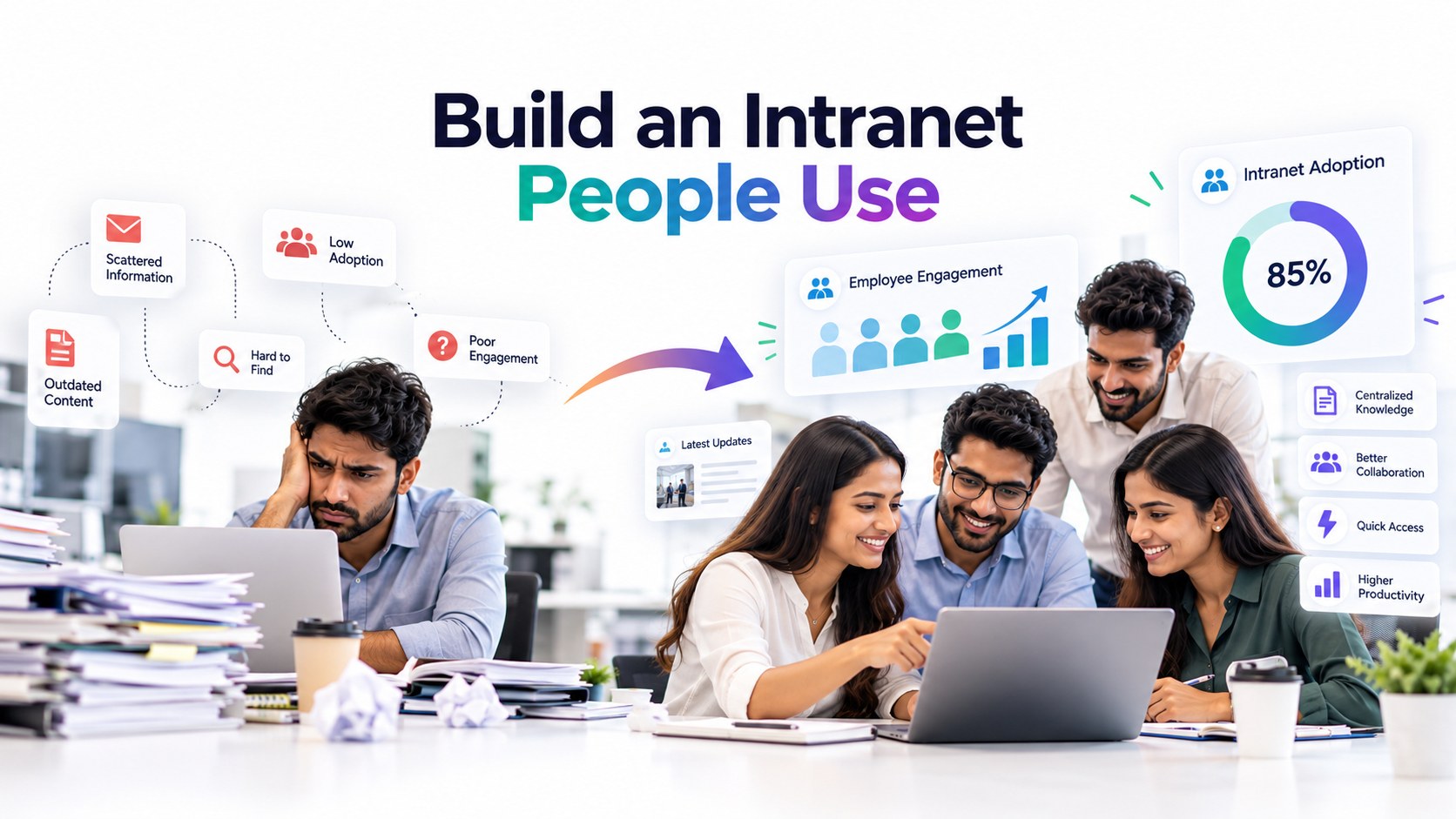
- Poor user adoption: Outdated interfaces discourage employees. The default behavior remains email, defeating the purpose of a unified platform.
- Weak mobile accessibility: Employees can’t access resources on smartphones or tablets, limiting effectiveness for field teams and remote workers.
- Broken search and discoverability: Employees waste hours hunting for procedures, policies, and company updates because search returns irrelevant results.
- Compliance and security gaps: Uncontrolled document sharing, missing audit trails, and inability to enforce data loss prevention (DLP) policies create regulatory risk.
- Disconnected systems: Teams chats, SharePoint documents, and Power BI reports operate in silos instead of creating a unified employee experience.
The consequence of getting this wrong is significant. Organizations without a cohesive digital workplace experience see lower employee retention, reduced productivity, increased compliance violations, and unrealized ROI on their Microsoft 365 investments.
Here’s what we’ve seen consistently: legacy intranets fail to scale. As your organization grows from 500 to 5,000 employees, the governance structure breaks down. Content becomes stale. Navigation becomes even more confusing. User adoption actually declines rather than improves.

The Solution: Building a Modern SharePoint Intranet Platform
A modern SharePoint intranet platform solves these problems through intentional architecture and governance. Rather than treating the intranet as an IT project, forward-thinking enterprises treat it as a business transformation initiative involving IT, HR, Communications, and the business units themselves.
The modern SharePoint intranet approach addresses each pain point directly:
- Hub-based architecture: Centralizes navigation while allowing flexibility. Department-specific hub sites connect to Microsoft Teams channels, creating seamless workflows.
- Modern, mobile-first design: Higher adoption rates because the experience works flawlessly on phones, tablets, and desktops.
- Robust search with metadata: Faster information access through intelligent refiners and properly configured search schemas.
- Integrated workflows and Teams connectors: Employees complete work without toggling between tools.
- Governance framework with role-based access: Compliance and security built into the platform from day one.
Expert Perspective
Here’s what most guides won’t tell you: the difference between a failed SharePoint intranet and a thriving one usually comes down to planning and governance, not just the technology. We’ve worked with many enterprises that treated modern SharePoint intranet builds as IT-only projects. The ones that actually succeeded aligned IT strategy with HR onboarding needs, Communications distribution requirements, and business unit workflows. This cross-functional alignment is what drives adoption and measurable business outcomes.
When evaluating partners to help build your modern SharePoint intranet, prioritize these capabilities:
- Proven Microsoft 365 partnership credentials and SharePoint Online expertise
- Deep experience with Indian enterprise regulatory landscape and compliance requirements
- Strong change management and user adoption planning capabilities
- Post-launch support and governance frameworks that ensure long-term success
- References from similar-sized organizations in your industry
Why Leading Enterprise Businesses Choose Modern SharePoint Intranet Solutions
The choice between building a modern SharePoint intranet in-house, working with generic digital agencies, or partnering with specialized Microsoft expertise has real consequences for timeline, quality, and long-term success.
| Factor | Specialized Microsoft Partner | Generic Digital Agency |
|---|---|---|
| SharePoint Platform Expertise | Deep knowledge of hub sites, Teams integration, search optimization, and governance frameworks specific to SharePoint Online | Surface-level understanding of SharePoint; often treats it as a CMS rather than a collaboration platform |
| Microsoft 365 Integration | Seamless integration with Teams, Power Automate, Power BI, and Copilot; understands how to leverage the full ecosystem | Limited ability to connect SharePoint to other Microsoft 365 tools; missed automation opportunities |
| Change Management & Adoption | Proven methodologies for user training, early-adopter programs, and sustained engagement beyond launch | Technology-focused; often underestimates the organizational change required for successful adoption |
| Governance & Long-Term Support | Establishes governance frameworks, content lifecycle policies, and ongoing support structures that scale with your organization | Hands-off after launch; no ongoing governance means intranet deteriorates quickly |
Leading Indian enterprises choose specialized Microsoft partners because the stakes are too high for generic approaches. A modern SharePoint intranet that underperforms wastes both the technology investment and the organizational change effort required to implement it.
Most vendors get this wrong. Specialized partners bring battle-tested playbooks from working with dozens of organizations. They know which implementation patterns work, which governance structures scale, and how to navigate the specific challenges that Indian enterprises face, whether that’s integrating with localized HR systems, supporting multiple languages, or meeting industry-specific compliance requirements.
Industry Applications Across Indian Enterprise Sectors
Financial Services and Banking
Banks and financial institutions use modern SharePoint intranet platforms to centralize policy distribution, manage compliance documentation, and create secure workflows for regulatory audits. Role-based access ensures sensitive information reaches only authorized personnel. Integration with Teams enables real-time incident response across branches and back-office functions.
Manufacturing and Logistics
Manufacturing organizations leverage modern SharePoint intranet to distribute production schedules, safety alerts, and supplier information across multiple plants in real time. Mobile access ensures shop-floor teams stay informed. Document version control prevents confusion around updated procedures and specifications.
IT Services and Technology
IT services firms use the modern SharePoint intranet as a central project repository, knowledge base, and resource management hub. Teams can share best practices, access client documentation securely, and collaborate across geographically distributed delivery centers without toggling between multiple tools.
Healthcare and Pharmaceuticals
Healthcare organizations implement modern SharePoint intranet to manage patient protocols, regulatory documentation, departmental dashboards, and training materials. Compliance frameworks ensure sensitive health information remains secure. Real-time updates about policy changes reach clinical and administrative staff immediately.
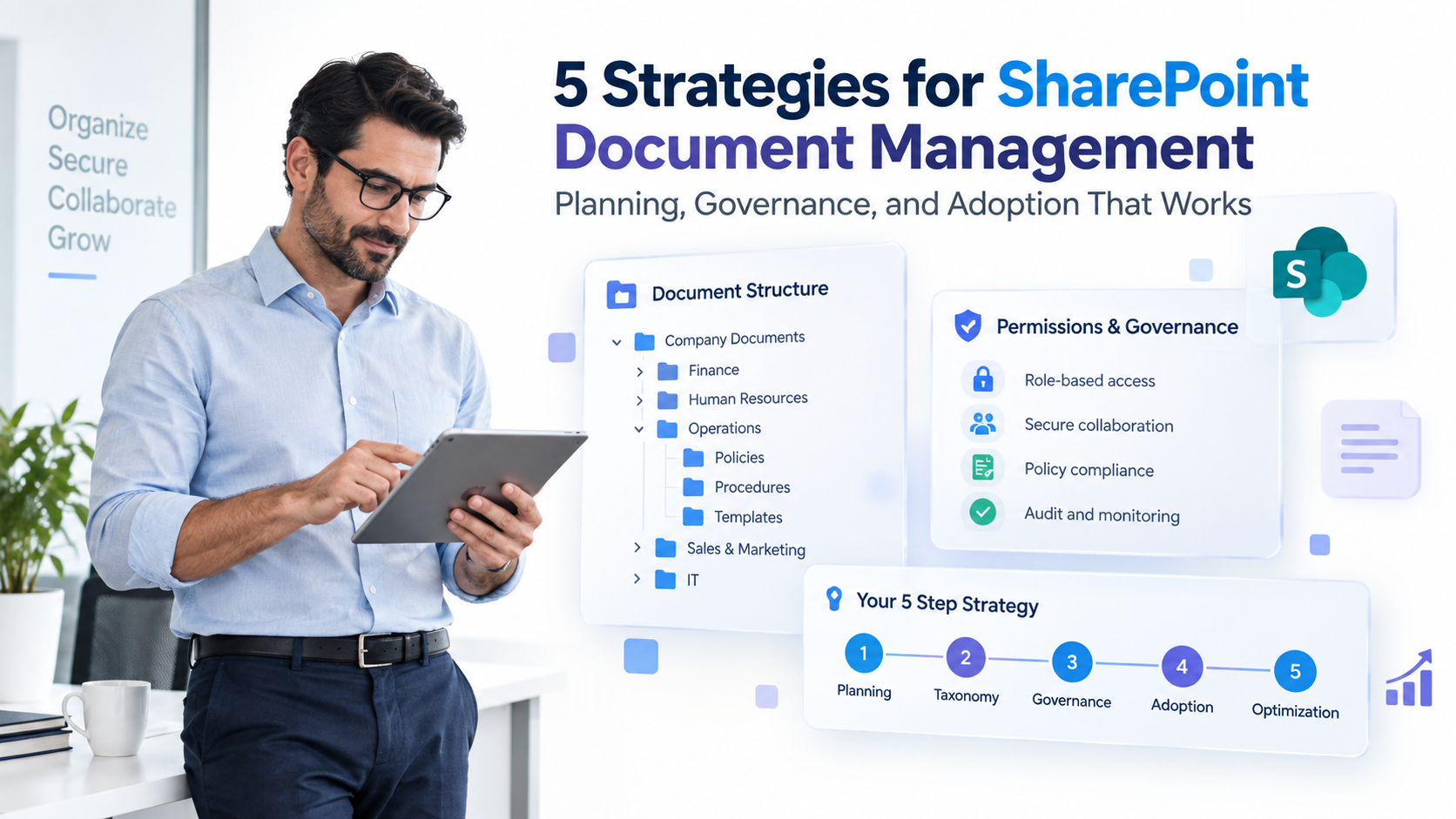
How to Get Started: 5-Step Implementation Approach
Building a modern SharePoint intranet requires a structured approach. Rather than rushing into technology, successful implementations start with strategy and planning.
Step 1: Discovery and Assessment
Action: Audit your current systems, document user personas across departments, and define clear success metrics aligned with business objectives.
Outcome: A comprehensive roadmap that addresses your specific challenges and aligns with your Microsoft 365 footprint.
Step 2: Design and Planning
Action: Develop information architecture, create a content taxonomy, define governance models, and build wireframes for stakeholder review.
Outcome: Stakeholder-approved design blueprint with clear roles, responsibilities, and decision-making authority.
Step 3: Build and Configuration
Action: Set up hub sites, configure content types, implement search refiners, establish Teams integration, and build custom workflows using Power Automate.
Outcome: Functional modern SharePoint intranet environment ready for content migration and user acceptance testing.
Step 4: Content Migration and Pilot Launch
Action: Migrate legacy content from file servers and old systems, train a pilot group of early adopters, gather feedback, and iterate on user experience.
Outcome: Refined platform with high pilot adoption rates and validated UX improvements before organization-wide rollout.
Step 5: Organization-Wide Rollout and Governance
Action: Execute full launch with communication campaign, comprehensive training programs, and ongoing support structures to sustain adoption.
Outcome: Sustained employee adoption, measurable engagement metrics, and a long-term governance structure that keeps the modern SharePoint intranet relevant and valuable.
Key Takeaway
Success requires intentional planning in Steps 1-2 and sustained governance in Step 5. Technology implementation (Step 3) is actually the easiest part. Organizations that rush through planning or skip governance universally see lower adoption and faster platform decay.
Frequently Asked Questions
What is the difference between SharePoint hub sites and communication sites?
Hub sites serve as aggregation points for related team sites and channels. They provide unified navigation, shared branding, and organizational hierarchy. Communication sites function as broadcast channels for announcements and news. In practice, modern SharePoint intranet strategies use hub sites as the primary organizing structure, with communication sites handling company-wide announcements at the top level.
How do I ensure high adoption rates for my modern SharePoint intranet?
Adoption depends on four factors. First, secure executive sponsorship and visible leadership support. Second, implement comprehensive change management and user training before launch. Third, create early-adopter programs in each department to serve as local champions. Fourth, establish feedback loops and iterate based on user input. Technology alone never drives adoption; change management and ongoing engagement do.
Can I integrate Microsoft Teams with my SharePoint intranet?
Absolutely. Modern SharePoint intranet strategies intentionally integrate Teams as the social and collaboration layer. You can create Teams-connected hub sites where Teams channels link to SharePoint document libraries, establishing a unified workspace. Workflows built in Power Automate can trigger across both tools, and search can surface both Teams conversations and SharePoint documents in a single result set.
How do I secure sensitive documents in a modern SharePoint intranet?
Security is built into the platform through multiple layers. Role-based access control restricts who can view specific content. Data loss prevention (DLP) policies prevent unauthorized external sharing. Sensitivity labels classify documents and enforce encryption. Conditional access policies ensure only compliant devices access sensitive information. Together, these controls create a secure environment that meets regulatory requirements while remaining usable for daily work.
What are the key metrics to measure modern SharePoint intranet success?
Track engagement metrics like site views, unique monthly visitors, and document downloads. Monitor search performance through refinement usage and click-through rates. Measure adoption across departments and how long it takes employees to find information compared to baseline. Survey user satisfaction regularly. Track content freshness to ensure the intranet remains current. These quantitative and qualitative metrics together paint a clear picture of whether your modern SharePoint intranet is delivering business value.
Taking the Next Step
Worth noting: building a modern SharePoint intranet isn’t a one-time project but an ongoing practice. The most successful organizations treat their intranet as a living platform that evolves with business needs. This requires establishing proper governance, designating content owners, and maintaining a regular cadence of updates and optimization.
On top of that, the relationship between your modern SharePoint intranet and employee experience platforms is increasingly important. As you build your modern SharePoint intranet, consider how it’ll integrate with Viva Engage, Viva Connections, and other employee experience tools that sit on top of Microsoft 365.
Many organizations also discover that SharePoint workflow automation becomes essential as the intranet matures. Processes that once required manual effort, document approvals, request routing, and compliance checks can be automated through Power Automate, reducing friction and improving consistency.
That’s why when evaluating partners to help build your modern SharePoint intranet, ask about their capabilities across the full Microsoft 365 ecosystem. The best modern SharePoint intranet implementations don’t operate in isolation. They leverage the full power of Teams, Power Automate, Power BI, and other platform capabilities to create truly integrated digital workplaces.
Build Your Enterprise Digital Workplace Today
A modern SharePoint intranet tailored to your organization’s unique needs can transform how your teams collaborate and communicate. Let our Microsoft expertise guide your strategy, from planning through launch and beyond. We help enterprises across India unlock the full potential of their Microsoft 365 investments.