SharePoint Consulting Services in India: Your Guide to Microsoft 365, Automation & AI Transformation in 2026
SharePoint consulting services in India have become essential as organizations modernize legacy systems, adopt cloud-first strategies, and prepare for artificial intelligence integration. A Mumbai-based pharmaceutical company recently discovered that 45% of their regulatory documents were scattered across three different SharePoint instances with no consistent metadata governance until they partnered with specialists who consolidated everything into a unified, AI-ready platform. Sound familiar? If your business struggles with document chaos, manual workflows, or uncertainty around Copilot readiness, you’re not alone.
Key Takeaway
SharePoint consulting isn’t about the software. It’s about unlocking the value hidden in your data, automating repetitive work, and building organizational capability for AI-driven decision-making. India’s leading consulting firms combine deep Microsoft expertise, vertical-specific knowledge, and cost-efficiency.
In This Article
- Why This Matters Now: India’s Digital Transformation Landscape
- The Core Challenge: What’s Holding Indian Businesses Back
- The Solution: SharePoint Consulting, Modernization & Automation Strategy
- Why Leading Indian Businesses Choose Professional SharePoint Consulting
- Industry Applications: Finance, Healthcare, Manufacturing & Government
- How to Get Started: Five Steps to Your Transformation Roadmap
- Frequently Asked Questions About SharePoint Modernization
Why This Matters Now: India’s Digital Transformation Landscape in 2025, 2026
India’s software and IT services industry is worth over $220 billion annually, and digital transformation has shifted from “nice to have” to survival imperative. According to NASSCOM’s 2024 Digital Transformation Report, 72% of Indian enterprises are actively investing in cloud modernization, workflow automation, and AI readiness. SharePoint and Microsoft 365 adoption in India’s core sectors, manufacturing, financial services, healthcare, and government, has reached critical mass.
The business drivers are clear: labor costs are rising, skill shortages persist, and competitive pressure from digital-native competitors is relentless. On top of that, regulatory frameworks like India’s data localization requirements, RBI guidelines for fintech, HIPAA readiness for healthcare exporters, and the Government of India’s Digital India initiative create both compliance urgency and opportunity for modernization.
“By 2026, 85% of enterprise workloads in India will run on cloud platforms. However, only 40% of organizations will have implemented governance frameworks to manage data effectively and prepare for AI integration.”
IDC Asia-Pacific Cloud Insights, 2025
Three forces converge right now to make SharePoint consulting services in India particularly valuable. First, cloud migration maturity means most organizations have moved beyond “do we go cloud?” to “how do we optimize what we’ve built?” Second, automation demand has never been higher. Excel-based reporting, email approval loops, and manual data entry represent massive hidden costs that AI can unlock. Third, Copilot and generative AI readiness is becoming a competitive differentiator, and success depends entirely on data quality and governance discipline.
India-based consulting firms bring unique advantages: proximity to your business, time-zone alignment for real-time collaboration, deep partnerships with Microsoft, access to NASSCOM-certified talent, and 20+ years of enterprise software experience, all at significantly lower cost than Western equivalents without sacrificing quality.

The Core Challenge: What’s Holding Indian Businesses Back
Every industry we work with faces similar obstacles. These pain points aren’t technology problems. They’re organizational and process problems that technology alone can’t solve:
- Legacy SharePoint sprawl: Multiple on-premises instances (2010, 2013, 2016) running in parallel, each with outdated governance, poor integration, and high total cost of ownership. Migration feels risky, so business units delay and entrench further.
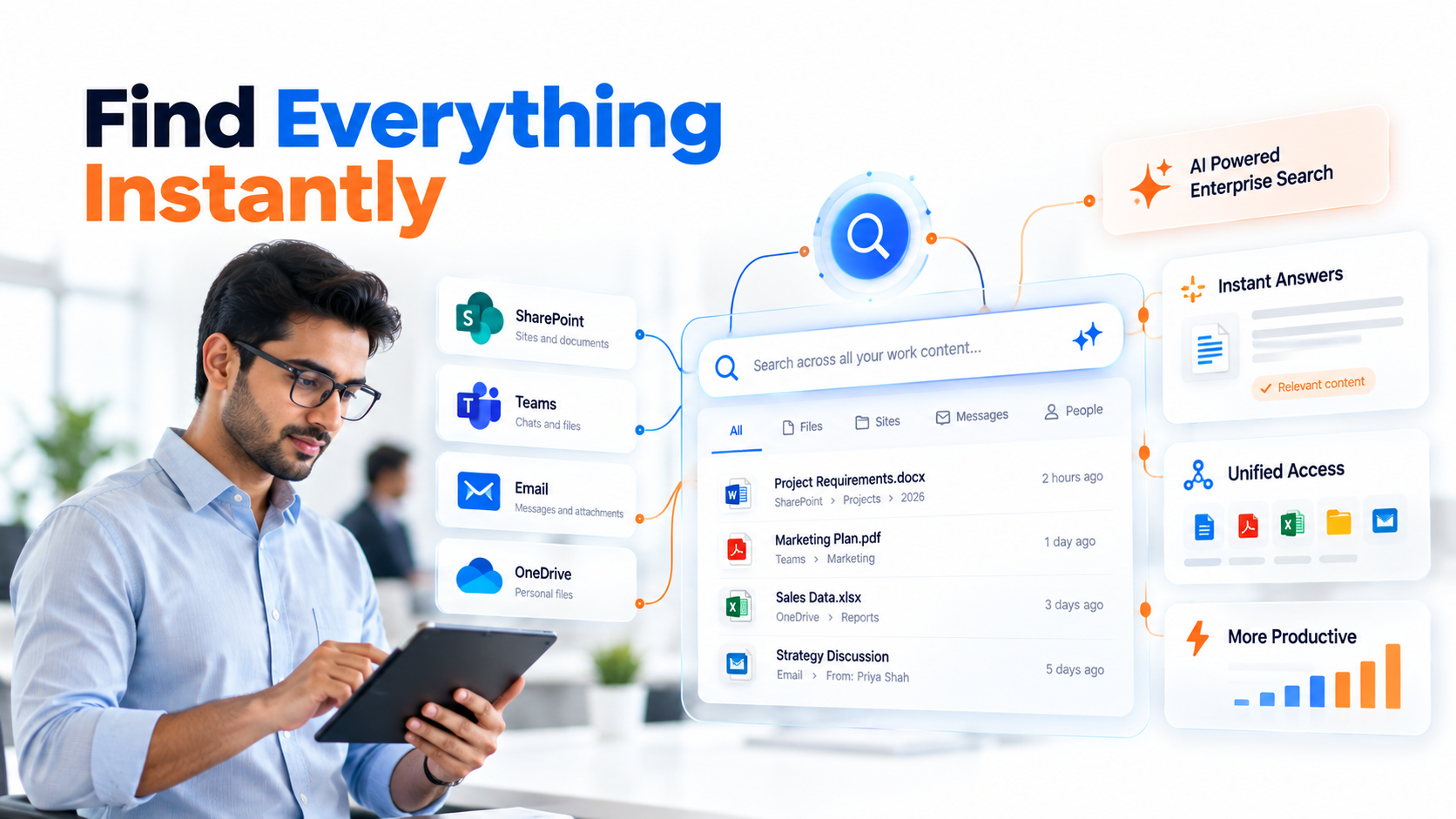
- Data chaos and information loss: Documents scattered across network drives, competing collaboration tools, email attachments, and multiple SharePoint sites with no single source of truth. Employees spend 25 to 30% of their time searching for information instead of using it.
- Manual workflows crushing team productivity: Approvals, compliance checks, data entry, report generation, and reconciliation still rely on email, Excel, and tribal knowledge. A financial services firm we worked with discovered their procurement team was processing 40% of approvals via email instead of using built-in workflows, adding 3 days to every purchase cycle.
- Governance breakdown and compliance exposure: No consistent metadata standards, poor records retention, inadequate access controls, and no audit trail for sensitive data. Healthcare organizations face HIPAA risk; fintech firms violate RBI guidelines; manufacturers struggle with ISO 27001 audits.
- Team fragmentation across tools: Sales uses Salesforce; HR uses Workday; Finance uses SAP; Operations uses Jira. Teams communicate via Teams channels and Outlook, but no integration means duplicate data entry and conflicting information.
- Copilot and AI readiness uncertainty: Organizations understand AI will transform work, but they’re unsure about data quality, privacy implications, governance models, and ROI. Fear of “black box” decisions paralyzes investment.
The consequence of inaction is measurable: missed automation ROI (often 30 to 50% of FTE capacity), regulatory risk, poor employee experience (frustration with clunky tools leads to shadow IT and security gaps), and competitive disadvantage as AI-native competitors accelerate decision-making velocity.
The Solution: SharePoint Consulting, Modernization & Automation Strategy
SharePoint consulting services in India address these challenges through a structured, phased approach. Rather than a “rip and replace” mentality, leading consultancies design a roadmap that balances speed, risk, and organizational capability.
Phase 1: Discovery & Readiness Assessment
Professional consultants spend 4 to 8 weeks understanding your landscape before recommending any action. This phase includes a comprehensive audit of existing SharePoint instances, data volume, user adoption patterns, governance maturity, and business process mapping. Worth noting: consultants also assess your organization’s readiness for change, technical skills, budget alignment, executive sponsorship, and appetite for new ways of working.
The outcome is a clear, phased roadmap (typically 12 to 24 months) with realistic timelines, resource requirements, and expected business outcomes. Organizations that skip discovery often face 6-month delays and 30%+ budget overruns.
Phase 2: Modernization & Architecture
This involves migrating or consolidating SharePoint instances to SharePoint Online (part of Microsoft 365), redesigning information architecture with clean metadata and content types aligned to business outcomes, and implementing governance frameworks. Policies include retention rules, data loss prevention (DLP) controls, access reviews, and records management aligned to regulatory requirements.
The result is a unified, scalable, compliant digital foundation that every business unit can trust.
Phase 3: Automation & Workflow Optimization
Process mining identifies high-volume manual workflows where automation creates the most ROI. Power Automate cloud flows replace email approvals and manual data entry. Robotic Process Automation (RPA) handles legacy system integration. Logic Apps orchestrate multi-step workflows across Teams, SharePoint, Dynamics 365, SAP, and custom APIs.
A manufacturing client reduced procurement cycle time from 7 days to 2 days. A healthcare organization automated 85% of regulatory document routing. A financial services firm eliminated 20,000 hours of annual manual reconciliation work.
Phase 4: AI & Copilot Readiness
Data preparation and semantic tagging ensure Copilot understands business context and retrieves relevant information. Governance frameworks define who can query what data, how insights are audited, and how responsible AI principles are enforced. Change management and upskilling programs help teams use Copilot effectively and ethically.
Organizations that invest in AI readiness gain competitive advantage in decision-making speed, pattern recognition, and insight generation.
Phase 5: Ongoing Management & Support
Managed services handle patch management, health monitoring, helpdesk support, and quarterly governance reviews. A dedicated center of excellence keeps the platform evolving in line with business needs and new Microsoft capabilities.
Expert Perspective
The most successful modernizations we’ve supported don’t rush to “go live.” They invest 4 to 8 weeks in discovery. Organizations that skip this phase or hire generalist consultants typically face scope creep, technology misalignment, and poor adoption. Here’s the thing most guides won’t tell you: data governance discipline is non-negotiable. It’s the foundation for automation and AI. Without it, you’re automating chaos.
What to Look for in a SharePoint Consulting Partner
Not all consultancies are equal. When evaluating SharePoint consulting services in India, prioritize partners who demonstrate the following:
- Proven Microsoft partnership: Gold or Platinum competency in Enterprise Content Management, Cloud Productivity, or Modern Work. This signals ongoing investment, technical depth, and access to Microsoft resources.
- Industry-specific experience: Deep knowledge of your vertical’s compliance requirements, process patterns, and technology stacks. A healthcare consultant understands HIPAA; a fintech consultant knows RBI guidelines.
- Hands-on technical depth: Real SPFx developers, Power Platform architects, governance specialists, not just “consultants” who design in PowerPoint. You need people who’ve built production systems.
- Change management and training capability: Technology fails without adoption. The best partners invest in your team’s capability-building, run structured training programs, and establish a center of excellence.
- Transparency on limitations: Trustworthy partners acknowledge trade-offs (e.g., rich customization vs. long-term supportability) and are honest about what won’t work. They’re willing to say “no” to bad ideas.
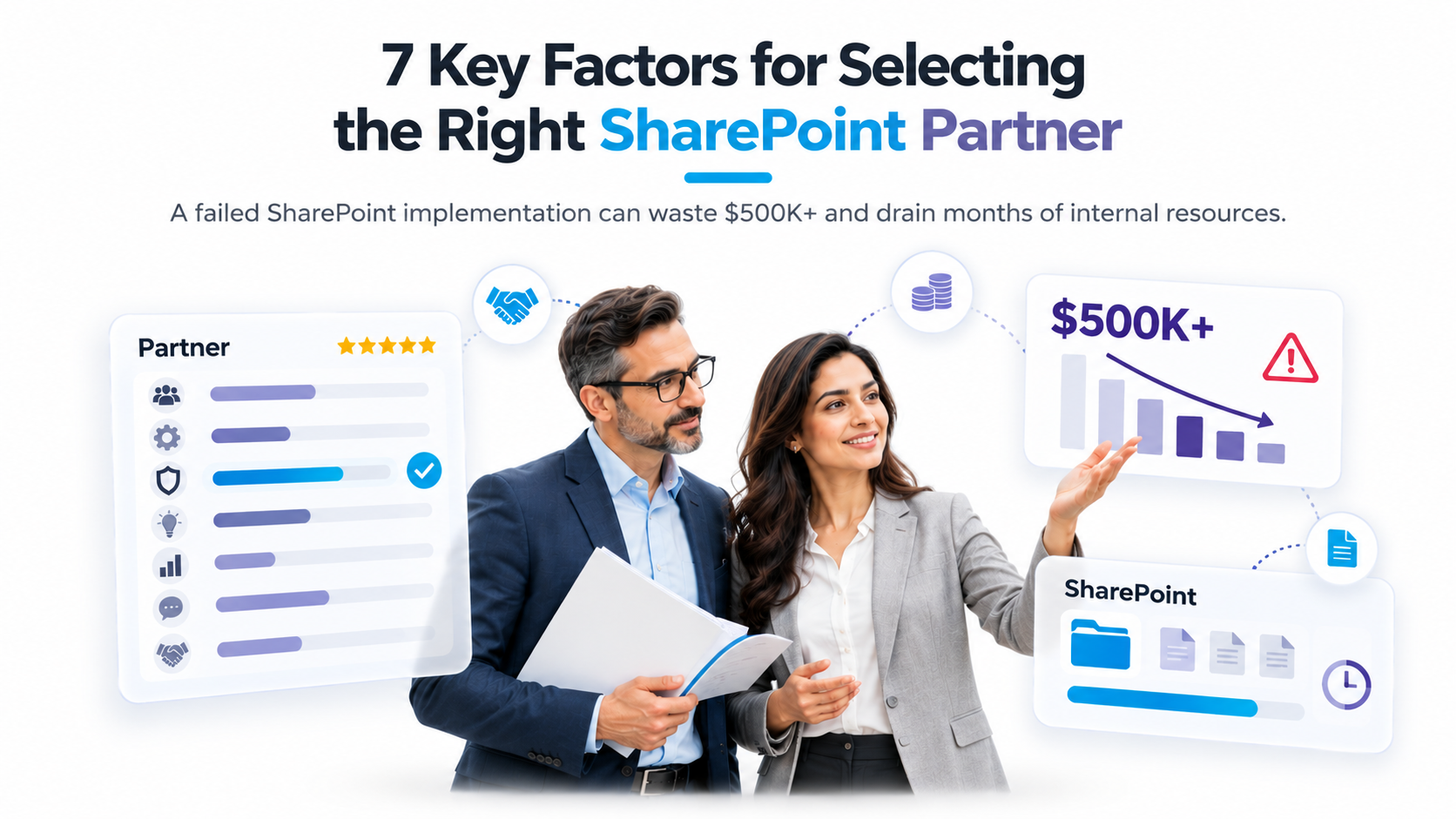
- References from similar-sized organizations in your industry: Talk to existing clients. Ask about discovery rigor, timeline realism, and post-launch support quality.
Why Leading Indian Businesses Choose Professional SharePoint Consulting
The choice between in-house teams, generic IT vendors, and specialized SharePoint consultancies comes down to speed, depth, and risk management. Consider the comparison:
| Capability | Specialized SharePoint Consultancy | Generic IT Vendor | In-House Team Only |
|---|---|---|---|
| Discovery Rigor | Industry benchmarking, best-practice roadmap, 4 to 8 week deep dive | Surface-level assessment, box-ticking approach | Biased toward existing skills, often misses optimization opportunities |
| Technical Depth | Deep SPFx, Power Platform, governance, and architecture expertise | Broad but shallow; support model often weak post-launch | Generalist knowledge; skill gaps common for complex scenarios |
| Change Management | Structured adoption program, team capability-building, COE setup | Transactional delivery; minimal upskilling or stakeholder management | Limited capacity due to competing operational priorities |
| Speed to Business Value | Fast delivery without rework; proven accelerators and patterns | Moderate speed; high rework risk due to surface-level design | Slow; internal learning curve and competing work delays progress |
Specialized SharePoint consulting services in India deliver value in three ways. First, they compress timelines. What might take your internal team 18 months takes a specialized firm 10 months, with lower risk. Second, they bring lessons learned from 50+ similar engagements; they avoid the mistakes most organizations make. Third, they build your internal capability, so you’re not dependent on external support indefinitely.
Cost-efficiency is often overstated as a reason to hire consultants. The real reason is speed, risk reduction, and the ability to focus your internal team on core business work while experts handle complex technical and organizational challenges.

Industry Applications: Finance, Healthcare, Manufacturing & Government
SharePoint modernization isn’t one-size-fits-all. Each industry faces unique regulatory, process, and data governance challenges. Here’s how leading organizations are transforming:
Financial Services & Fintech
Banks and fintech firms use SharePoint consulting services in India to modernize compliance workflows, automate KYC/AML processes, and implement records management aligned to RBI guidelines. A major asset management firm consolidated five on-premises SharePoint instances into one governed, audit-ready platform, reducing compliance audit time by 60%. Power Automate automations route loan approvals and regulatory filings through proper channels without manual handoffs. Copilot-ready data governance ensures that AI-generated risk insights are traceable and explainable to regulators.
Healthcare & Life Sciences
Healthcare organizations implement SharePoint consulting services to manage patient data securely, automate clinical workflows, and ensure HIPAA compliance. A hospital network reduced appointment scheduling from 3 days to same-day by automating physician availability checks and patient communication. Healthcare consultants implement role-based access controls, encryption, and audit trails. Research organizations use SharePoint as a central repository for clinical trials data, enabling faster analysis and regulatory submissions.
Manufacturing & Supply Chain
Manufacturers use SharePoint consulting to consolidate supplier documents, automate procurement workflows, and implement quality management systems. A logistics company reduced supplier onboarding from 5 days to 1 day by automating document collection and compliance verification. Manufacturing consultants integrate SharePoint with ERP systems, enabling real-time visibility into quality records, certifications, and change management processes.
Government & Public Sector
Government agencies modernize SharePoint to align with Digital India initiatives, improve inter-agency collaboration, and implement records management and open-data governance. PSUs use SharePoint to centralize procurement records, audit trails, and citizen-facing transparency. Data residency and sovereignty requirements demand India-based consulting expertise familiar with government compliance frameworks.
How to Get Started: Five Steps to Your Transformation Roadmap
Beginning your SharePoint modernization journey doesn’t require a massive commitment. Follow these five steps to move from uncertainty to clarity:
- Define your business outcome: What problem are you solving? Is it data chaos, manual workflows, compliance risk, or AI readiness? Clarity on desired outcome drives everything downstream. Partner discussions become focused and concrete.
- Audit your current state: Inventory existing SharePoint instances, data volume, user base, governance maturity, and integration touchpoints. Understanding your baseline is essential for realistic timelines and budgeting. A good consultant handles this with minimal disruption to your operations.
- Engage with specialized consultants: Request discovery calls with 2 to 3 firms offering SharePoint consulting services in India. Evaluate their approach, industry experience, technical depth, and cultural fit. Ask for references. A rigorous discovery conversation (not a sales pitch) signals a serious partner.
- Develop a phased roadmap: Work with your chosen consultant to define phases, milestones, resource requirements, and success metrics. A credible roadmap is transparent about what’s uncertain and builds in discovery gates to validate assumptions before major investments.
- Launch the first phase: Begin with a focused pilot or “quick win” that demonstrates value, builds internal momentum, and validates your consultant’s approach. Success in phase one increases executive confidence for subsequent phases.
This approach minimizes risk and keeps momentum building. Organizations that follow this structured pathway typically achieve measurable business impact within 6 months and full transformation maturity within 18 to 24 months.
Frequently Asked Questions About SharePoint Modernization
Should we migrate to SharePoint Online immediately, or keep on-premises instances running?
That depends on your data security requirements, integration complexity, and business readiness for change. A discovery assessment evaluates both options and provides clear trade-offs. Most organizations migrate to SharePoint Online within 12 to 18 months because cloud offers better integration with Microsoft 365, lower TCO, and faster access to new features like AI and Copilot. That said, some organizations with strict data residency or legacy system dependencies optimize on-premises first, then migrate incrementally.
How do we know if our data is ready for Copilot and AI?
Data readiness has three dimensions: quality (accurate, complete, current), governance (clear metadata, access controls, retention policies), and structure (organized in ways AI can understand and query). A specialized assessment evaluates these dimensions and identifies gaps. Most organizations need 3 to 6 months of data cleansing and semantic tagging before Copilot delivers reliable insights. That’s normal; it’s not a barrier, just a required step.
What’s the difference between hiring a SharePoint consultant versus building an internal team?
Consultants bring specialized expertise and speed; internal teams bring context and long-term continuity. The best approach combines both: hire consultants to design, implement, and build your internal capability, then establish an internal center of excellence to manage the platform long-term. This hybrid model delivers faster transformation without creating permanent consultant dependency.
How do we measure success after implementation?
Success metrics depend on your business outcome. If the driver is automation, measure FTE time savings, cycle-time reduction, and error rates. If it’s collaboration, measure employee engagement, information-discovery time, and cross-team project velocity. If it’s compliance, measure audit findings and time to close non-conformances. Define metrics in your roadmap before implementation begins, then measure monthly. Real outcomes drive continued investment and organizational buy-in.
What’s the biggest risk we should watch out for?
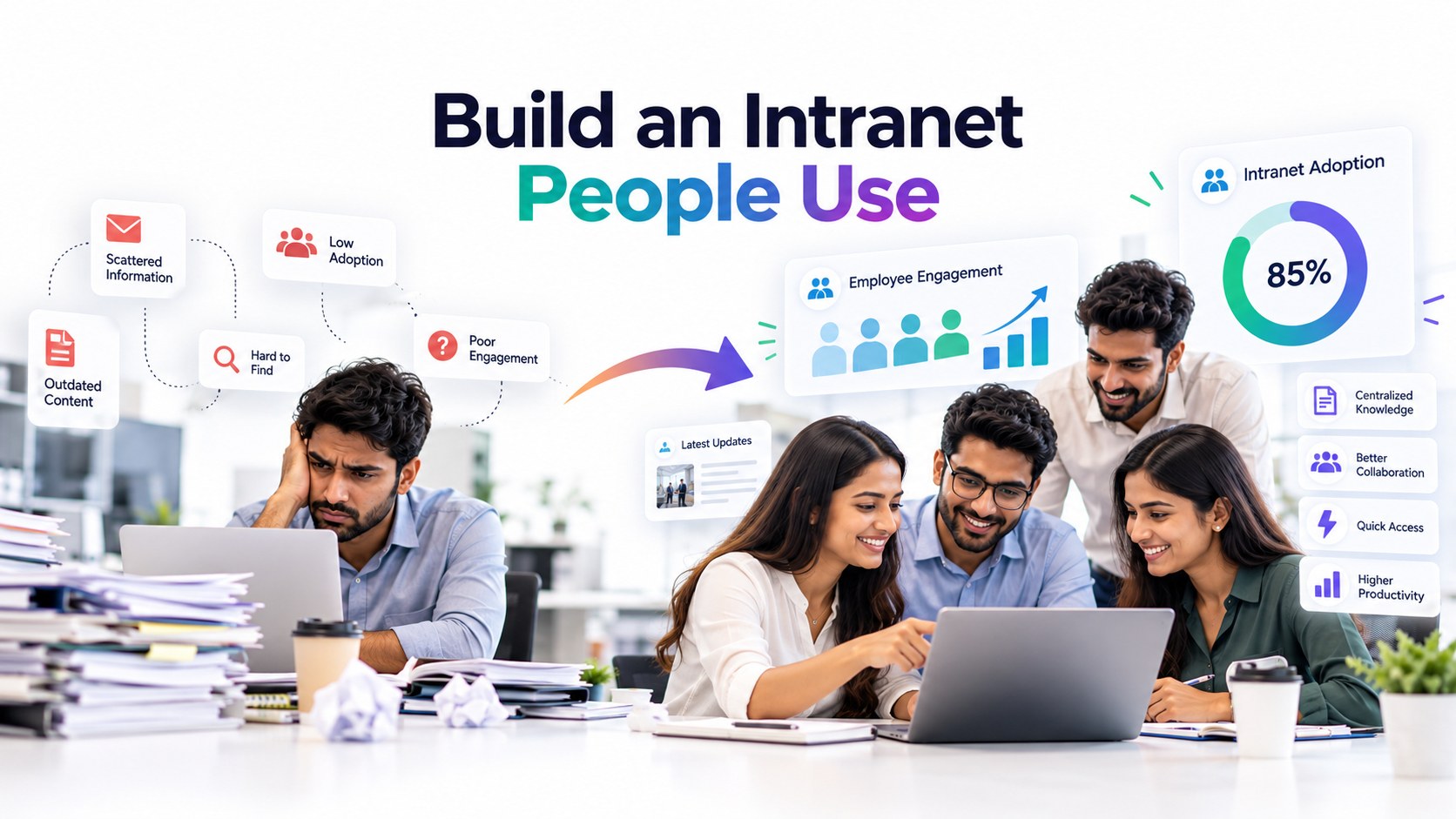
The biggest risk is poor adoption. Organizations often invest heavily in technology but underestimate the organizational change required. Without executive sponsorship, structured training, and incentives aligned to new ways of working, teams revert to old habits. The best consultants manage adoption as aggressively as they manage technology. Change management isn’t optional; it’s foundational.
For deeper guidance on automating specific workflows, see our detailed guide on how Power Automate can transform procurement processes. Additionally, learn more about SharePoint migration services, benefits, and best practices to ensure a smooth transition. For document governance strategies, explore our resource on leveraging document management systems to ensure compliance without compromising efficiency.
Ready to Transform Your SharePoint and Microsoft 365 Environment?
A clear roadmap, specialized expertise, and structured change management unlock significant value: faster decision cycles, 30 to 50% automation ROI, and competitive advantage through AI-ready data. Let’s explore what transformation looks like for your organization.