Stop Managing Multiple File Versions: Multi-City Team Document Collaboration Guide for India’s Growing Enterprises
Multi-city team document collaboration is one of the most underestimated operational challenges we see in India’s growing enterprises. When teams across Mumbai, Bangalore, and Pune work off different versions of the same files, productivity stalls, compliance risks multiply, and decision-making slows to a crawl. It’s 9:30 AM in Mumbai, your regional finance team opens the Q3 budget file. Meanwhile, the Bangalore branch is editing a version from yesterday. By noon, the Pune office has uploaded another revision. No one knows which is current.
Key Takeaway
Organizations managing teams across multiple Indian cities spend 15-20% of their IT resources managing document version conflicts instead of strategic initiatives. The right centralized system transforms this chaos into streamlined, compliant collaboration.
In This Article
- Why This Matters Now for Indian Enterprises
- The Core Challenge: Why Version Control Breaks Across Regions
- The Solution: Centralized Document Management for Multi-City Teams
- Why Leading Multi-Office Businesses Choose Unified Document Systems
- Industry Applications: How Teams in Your Sector Use Multi-City Collaboration
- How to Get Started
- Frequently Asked Questions
Why This Matters Now for Indian Enterprises
India’s post-pandemic workplace is permanently hybrid and multi-location. The National Association of Software and Service Companies (NASSCOM) reports that 67% of Indian enterprises now operate across 3 or more cities, yet only 34% have unified digital document workflows. This gap creates operational friction that compounds every quarter. Regional directors know the problem exists. They live it every day.
Consider the city-specific business landscape. Mumbai hosts financial services, insurance, and pharma headquarters with stringent compliance burdens. Bangalore drives the tech and startup ecosystem, demanding real-time synchronization across fast-moving teams. Pune anchors auto, IT services, and manufacturing operations with complex cross-departmental workflows. Each city operates on different rhythms and regulatory expectations, yet they’re expected to move as one organization.
“Organizations with distributed offices face a 30-40% productivity loss due to fragmented document workflows and version control chaos.”
Gartner Enterprise Content Management Market Report, 2023
The cost of inaction isn’t abstract. When your Mumbai finance team can’t verify which budget spreadsheet is current because three versions exist in three inboxes, approvals delay. When your Bangalore product team can’t find the latest specification document because it’s locked on someone’s computer, development pauses. When your Pune manufacturing team operates from last week’s quality checklist, compliance audits fail. Multi-city team document collaboration isn’t a nice-to-have. It’s an operational necessity.
The Core Challenge: Why Version Control Breaks Across Regions
Email attachment chaos starts innocently. Your Mumbai office emails a budget file to Bangalore. Bangalore edits it and replies all. Pune opens the original email and makes different changes. Now three versions exist, stakeholders don’t know which is authoritative, and critical decisions rest on outdated information.
This breakdown happens systematically. Here are the six critical failure points:
- Email attachment chaos: Files are shared via email, creating exponential versions and lost edit context. After three rounds of replies, no one remembers who edited what or when.
- Time zone collaboration friction: When Mumbai hands off work to Bangalore, then to Pune across sequential time zones, file-locking prevents real-time co-authoring. Teams wait in handoff queues instead of working simultaneously.
- Compliance and audit blindness: When a regulatory audit arrives, you can’t prove who edited which financial statement, approved which contract, or authorized which decision. The paper trail vanishes into email archives.
- Access control nightmares: Shared drives or generic cloud folders lack granular permission management. A junior intern accesses confidential board minutes. A departed employee retains access to sensitive payroll data.
- Onboarding delays: New regional team members spend days searching for the “source of truth” document. They don’t know if the latest version is in someone’s Downloads folder, a shared drive, or an email thread from six months ago.
- Accidental overwrites: Simultaneous edits cause data loss. Your Mumbai and Bangalore teams edit the same document at 3 PM, and one person’s changes vanish. Conflict resolution becomes manual firefighting.
Getting this wrong is severe. Fragmented multi-city team document collaboration doesn’t just slow workflows. It creates regulatory exposure, erodes data integrity, forces IT teams into firefighting mode, and prevents your organization from moving at the speed your business demands.
The Solution: Centralized Document Management for Multi-City Teams
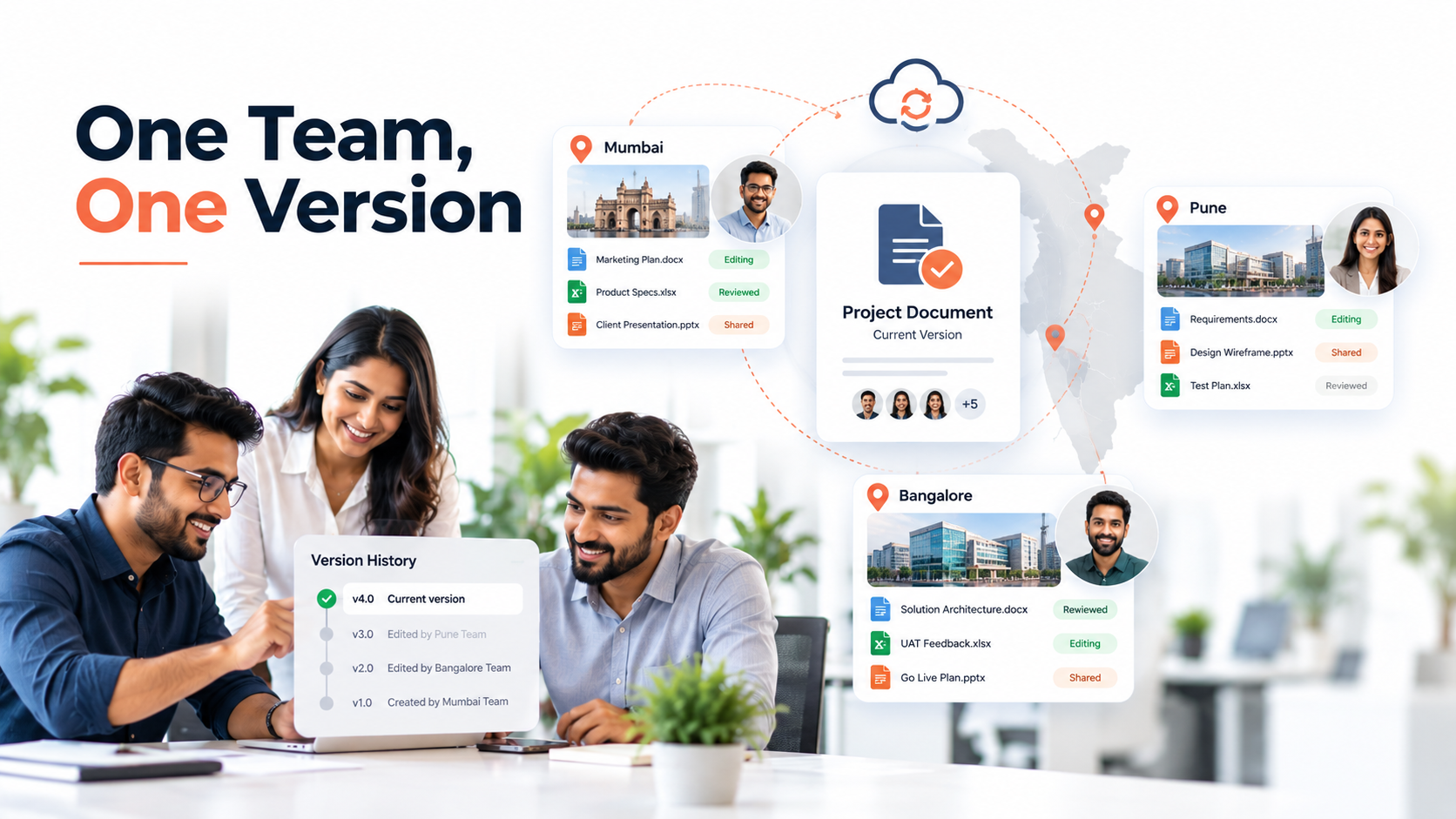
Centralized document management solves each pain point systematically. A unified repository accessible across Mumbai, Bangalore, and Pune means one source of truth, not scattered emails and folders. All versions store centrally with a complete audit trail showing who edited what, when, and why.
Here’s how the right approach addresses each critical gap. Real-time co-authoring allows multiple users across regions to edit simultaneously without file locks blocking productivity. Role-based access control ensures interns see only what they should. Confidential documents remain restricted. Compliance audits pass because complete modification histories exist. Smart search by metadata, content, or ownership replaces folder-guessing. Automated workflows, approval chains, retention policies, and archival eliminate manual coordination.
When integrated with Microsoft 365, Teams, Outlook, and OneDrive, a modern document management system fits into how your teams already work. Employees don’t learn a foreign tool. They use familiar interfaces with powerful centralization underneath.
Expert Perspective
In our work with clients, we’ve learned that centralized multi-city team document collaboration works best when paired with deliberate governance design and user change management. The technology solves 60% of the problem. The other 40% comes from defining who has access to what, training staff on new workflows, and optimizing processes after launch based on real usage patterns. Implementation without governance creates a beautiful empty system. Governance without technology recreates the chaos with more structure.
What should you evaluate in a partner? Look for prior hands-on experience with multi-location enterprises. Ask about change management and training support, not just software setup. Evaluate their post-launch optimization approach. Ask for references from organizations similar to yours in size and regional spread. The right partner doesn’t impose a one-size-fits-all template. They design governance around how your specific teams work.
Why Leading Multi-Office Businesses Choose Unified Document Systems
Organizations managing teams across Mumbai, Bangalore, and Pune often evaluate multiple approaches to multi-city team document collaboration. The comparison reveals why unified systems outperform legacy workflows and generic cloud storage.
| Capability | Unified Document Management | Generic Cloud Storage | Uncontrolled File Sharing |
|---|---|---|---|
| Version Control | Advanced with complete audit trail and automatic conflict resolution | Basic version history with limited metadata | Manual, error-prone, email-based |
| Regional Compliance | Built for RBI, MCA, and industry regulations without retrofitting | Generic compliance, not India-specific | No compliance features |
| Real-Time Collaboration | Full co-authoring across time zones with simultaneous edits | Partial, often requires manual syncing | Blocked by file locking and sequential handoffs |
| Permission Management | Granular, role-based, metadata-driven, audit-logged | Folder-level only, limited sophistication | Folder access or shared passwords |
| Workflow Automation | Approval chains, retention policies, e-signatures, archival | None, manual coordination required | None, manual process |
| Search and Discovery | AI-assisted, metadata-driven, full-text, with intelligent suggestions | Basic content search, limited context | Folder browsing by memory |
Three factors distinguish a comprehensive approach to multi-city team document collaboration from alternatives. First, India-first compliance design means the system is built for RBI, MCA, and industry-specific regulations from day one. No localization retrofitting. Second, multi-regional rollout expertise. Your partner has deployed across 50+ multi-city enterprises. You’re not their first rodeo. They know the mistakes organizations make and how to prevent them. Third, a phased approach replaces rip-and-replace trauma. You migrate gradually, train staff in phases, and optimize based on real usage rather than imposing vendor templates on your workflows.
Regional Operations Directors worry that “enterprise” solutions are bloated and slow. A thoughtful implementation starts with your actual workflows, not vendor assumptions. Over 6 to 8 weeks, a dedicated team maps your existing processes, designs tailored permissions, configures integrations, trains your people, and hands off a system that feels natural, not imposed from outside.
Industry Applications: How Teams in Your Sector Use Multi-City Collaboration
Finance and Insurance: Centralized Audit and Cross-Regional Approvals
Mumbai-based financial services and insurance firms operate compliance workflows across three or more cities. Multi-city team document collaboration enables centralized audit documentation, real-time budget and forecasting file collaboration, and automated approval workflows for financial instruments. Here’s a typical workflow: Regional Finance Manager submits Q3 budget from Pune. Mumbai CFO approves in real-time. Document archives automatically with complete modification history. When auditors arrive, the full trail is instant and irrefutable.
Technology and IT Services: Code, Architecture, and RFP Management
Bangalore-headquartered tech firms with centers in Mumbai and Pune use multi-city team document collaboration for code documentation, architecture diagrams, and client RFP management. Every engineer sees the same latest specification. Client deliverables never exist in multiple versions. When a developer in Bangalore asks “What did we promise the client?”, the answer is immediate and authoritative.
Pharma and Healthcare: Clinical Trial and Regulatory Documentation
Multi-state pharma operations manage compliance-intensive clinical trial documentation, regulatory submissions with complete change tracking, and quality assurance batch records across Mumbai, Bangalore, and Pune facilities. Regulatory audits historically consumed weeks of manual file gathering. With complete audit trails and automated retention policies, the same audit completes in days. Compliance becomes demonstrable rather than aspirational.
Retail and Logistics: Store Operations and Supply Chain Sync
Pan-India retail and logistics networks use multi-city team document collaboration for inventory and supply chain file management, store operations manuals distributed to all branches, and real-time sales and shipment tracking documents. New store openings historically waited weeks for operational documentation to be finalized across regions. Now documentation synchronizes on day one. Store managers don’t wonder which manual is current. They know.
How to Get Started
Moving from fragmented file sharing to unified multi-city team document collaboration follows a clear, low-risk path. Each step builds on the previous one, ensuring your team understands the system before full deployment.
- Assessment Workshop: Your IT Head and Operations Director meet with the implementation team to map current document flows, identify critical pain points, and clarify compliance requirements. Outcome: A clear picture of your “as-is” state and specific challenges.
- Governance and Architecture Design: The team defines user roles, permission models, retention policies, and integration points with your existing tools. Outcome: A tailored, documented roadmap customized to your organization, not a generic template.
- Phased Pilot Deployment: One department, typically Finance or Operations, tests the system, provides feedback, and identifies real-world adjustments. Outcome: Hands-on insights before enterprise-wide rollout, with staff confidence built from early success.
- Migration and Staff Training: Existing files move to the centralized repository, the system configures fully, and all users receive hands-on training in how the platform fits their daily work. Outcome: Smooth adoption with minimal business disruption and staff confidence in the new workflow.
- Optimization and Ongoing Support: The team monitors real-world usage, refines workflows based on feedback, and provides continuous support as your organization scales. Outcome: The system evolves with your business instead of becoming a static tool.
This approach prevents the most common failure mode. Organizations buy powerful software, install it, train briefly, then wonder why adoption stalls. Multi-city team document collaboration adoption requires that your team understands not just the tool, but why each feature matters to their specific work.
Frequently Asked Questions
Will our team need to change how they work?
Change is minimal and deliberately designed that way. The interface resembles OneDrive or Google Drive. Familiar to most staff. Workflows are designed around how your teams already work, just more efficiently and with better oversight. Change management training is built into the implementation. Staff understand not just what to do, but why the new approach solves their actual pain points.
How long before we see productivity gains?
Early wins appear within the first few weeks: reduced email clutter, faster file discovery, and eliminated version confusion. Larger process improvements like workflow automation, compliance time savings, and better cross-office coordination emerge over subsequent months as teams internalize new habits and the system reaches full optimization.
Is this solution only for large enterprises?
No. Organizations with 50 or more employees across two or more locations benefit most from centralized multi-city team document collaboration. Smaller teams may find simpler solutions sufficient. That said, the compliance and version-control benefits apply regardless of company size.
What about data security and India regulatory compliance?
The system is designed specifically for RBI, ISO 27001, and MCA compliance requirements. Data stays within India with no cross-border transfer. Complete audit trails satisfy regulatory requirements. Every document modification is logged with user identity, timestamp, and change details. Exactly what auditors and regulators expect to see.
Can this integrate with our existing tools like Outlook, Teams, and Salesforce?
Yes. SharePoint and modern document management systems integrate natively with Microsoft 365 ecosystem tools including Outlook, Teams, and Power Automate. Custom integrations with other platforms are possible depending on your specific tech stack and business requirements.
Transform Multi-City Document Chaos Into Streamlined Collaboration
Stop losing time to version conflicts and compliance risks. AscenWork’s multi-city team document collaboration solutions are purpose-built for India’s distributed enterprises across Mumbai, Bangalore, and Pune.